


Hello everybody! I know some of you have been waiting for my doenjang and ganjang recipes for a long time! Today I feel a real sense of achievement to release this recipe here. It’s one of the recipes in my cookbook, and whether you have my book or not, this video and recipe should still be useful to you.
Korean fermented soybean paste, called doenjang (된장), is more than just a seasoning or an essential ingredient in many iconic Korean dishes. It’s part of who we are as Koreans and how we see ourselves. A meal of rice, kimchi, doenjang-soup (or doenjang-stew), and a few side dishes is for many Koreans, the definition of a meal: breakfast, lunch, or dinner. It’s impossible for us to imagine life without doenjang.
Salty, earthy, hearty, incredibly savory and delicious, it adds flavor to many dishes and makes them distinctively Korean. Making doenjang at home takes a long time, you have to be ready to commit to it for one year! It’s not hard to make, but takes patience and some hard work, and some special equipment. But as a bonus, Korean soup soy sauce (guk-ganjang:국간장) is a byproduct of making doenjang, so you get that delicious soy sauce for free!
Of course, you can always buy doenjang and guk-ganjang in a Korean grocery store, which is what most Koreans do. But the taste of store-bought can’t be compared to homemade doenjang and guk-ganjang, you will be knocked out over how delicious they are! And I’ve never found a brand of soup soy sauce in the store that satisfied me, which is why I always use fish sauce in my recipes as a substitute.
Besides the taste, making your own is fun and satisfying to eat. Over years of making, tasting, and fermenting these iconic Korean sauces, you’ll develop experience and sophistication in fermenting and eventually become a Korean food expert.
This video was a lot of fun to make. The recipe took me 2 years to develop, and the video took another year to film. It’s finally finished and I couldn’t be happier to share my recipe with you! Koreans traditionally start the process in the winter because the weather is good for drying soybean blocks. But I discovered that indoors, in my apartment in New York, any time is a good time to start making doenjang.
I hope you try it! Enjoy the recipe!
Special equipment
- An electric mat or blanket, or ondol-style heating in your house
- Cotton flour sacking or cheesecloth
- Cotton butcher’s twine
- A large shallow bamboo basket about 17 inches in diameter, or a large baking pan lined with waxed paper
- Dried rice straw or hay that’s been well washed and dried (optional)
- A cardboard box (an 18-x-10-x-7-inch box will hold 3 bean blocks)
- A 4- to 5-gallon Korean earthenware crock (hangari) with a lid
- A 5-quart Korean earthenware crock (hangari) with a lid
- 3-5 dried jujubes (daechu)
- 3-5 large dried hot chili red peppers (any variety; about 4 inches long)
- 3 (4-x-1½-x-1-inch) pieces hardwood charcoal
Ingredients
Makes 10 pounds of doenjang
- 5 pounds dried yellow soybeans (meju-kong), picked over, rinsed, and soaked in cold water for 24 hours
- 3½ gallons water
- 5 quarts plus ½ cup kosher salt (2 three-pound boxes of Diamond Crystal brand Kosher salt)
- 2 tablespoons honey
Directions
Make meju blocks from soybeans
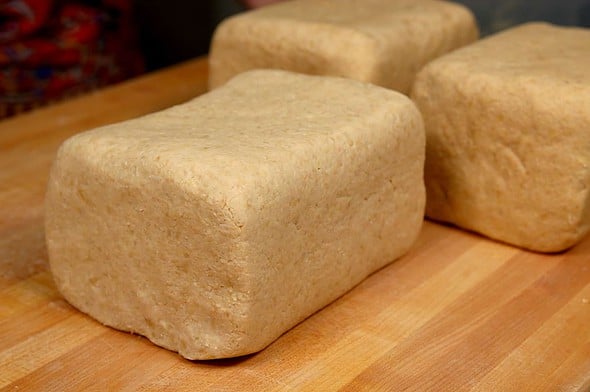
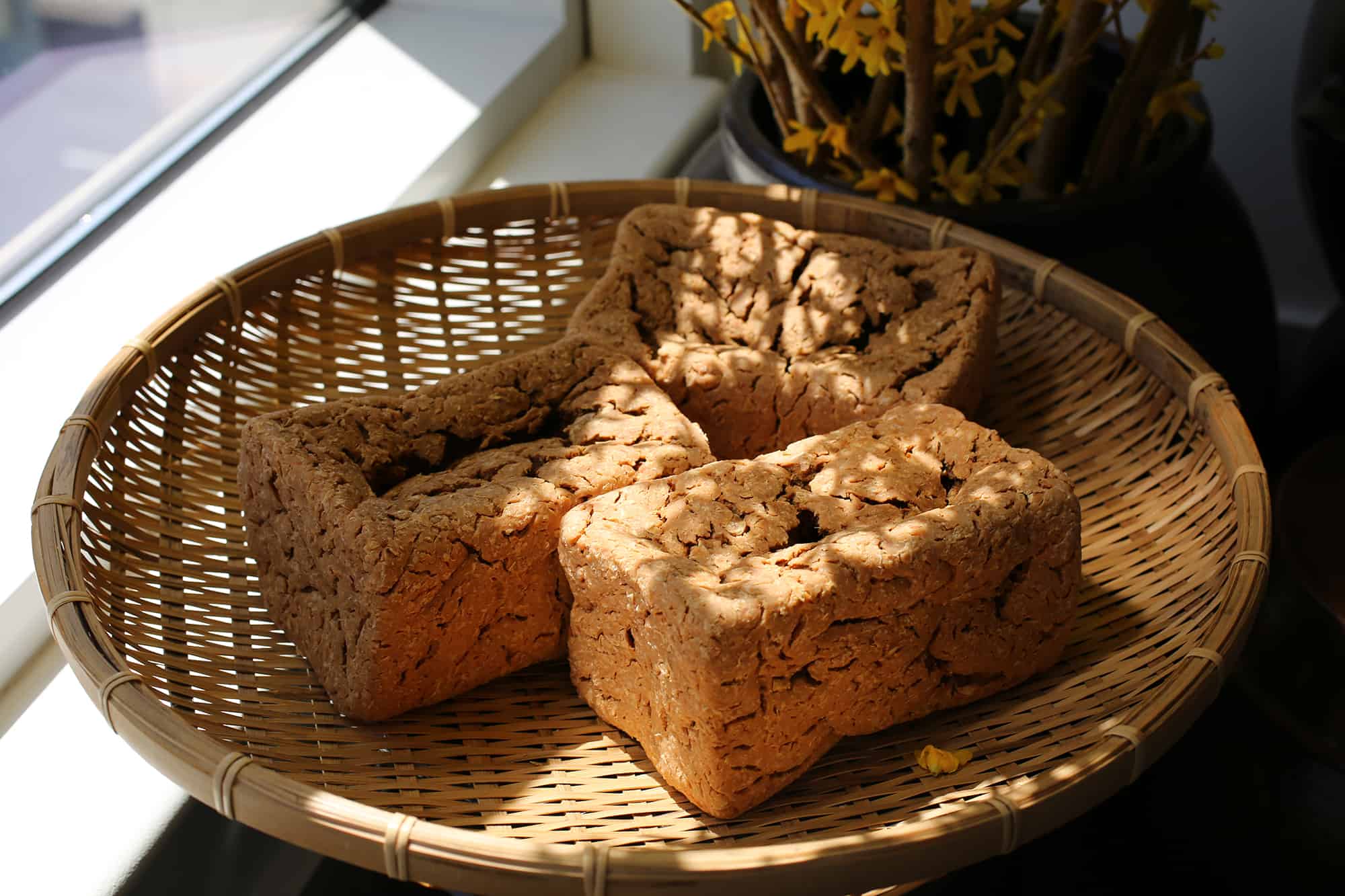
Blocks of crushed soybeans are called meju (메주) in Korean, and they’re the foundation of doenjang-making.
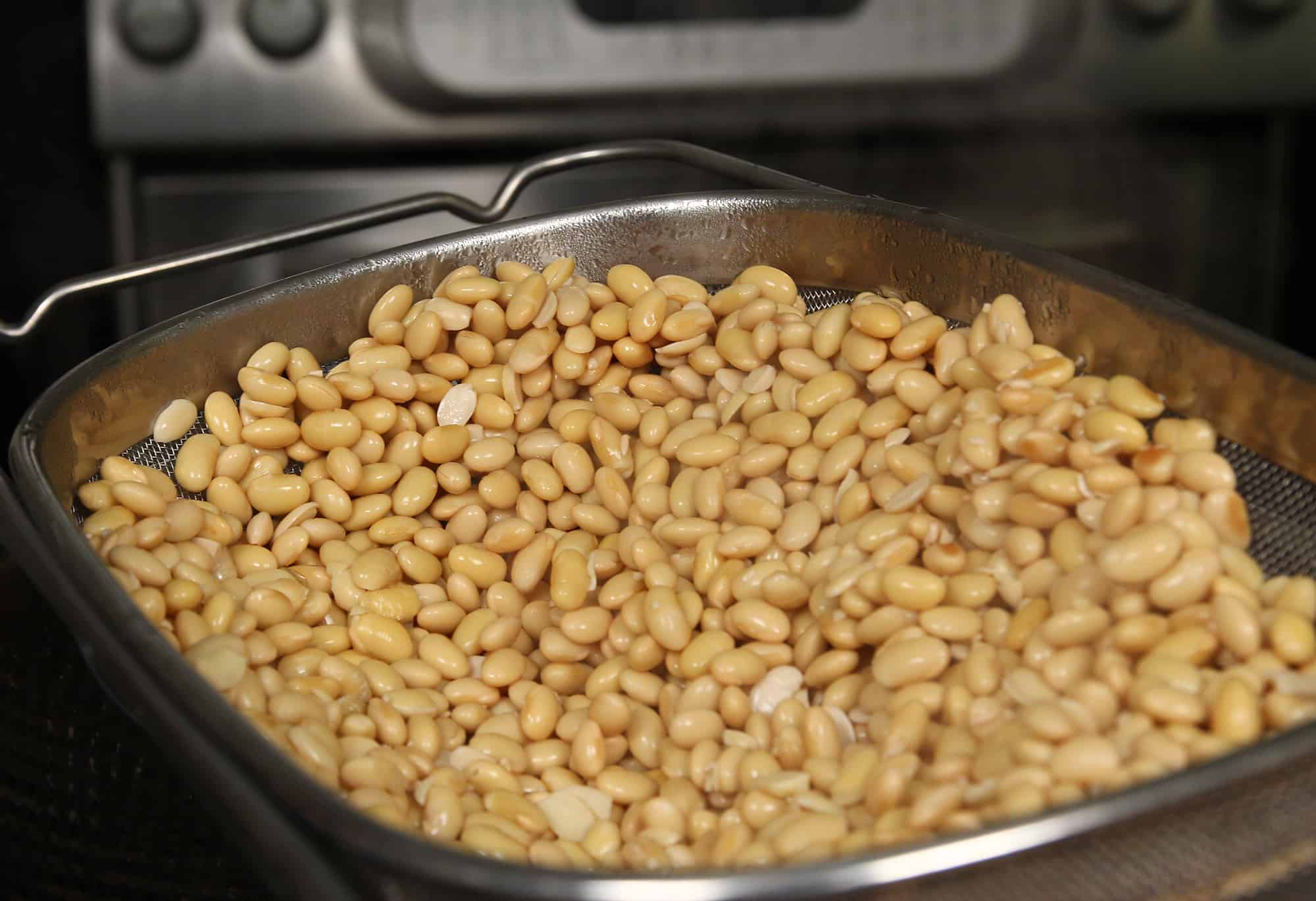
- Drain the beans and put them in a large heavy pot. Add water that is three times as deep as the beans, cover, and cook over medium-high heat for 1 hour.
- Turn the heat down to medium and continue cooking until the beans are soft enough mash easily, 4½ to 5 hours, checking to make sure the beans remain covered with water, and replenishing as necessary. Drain the beans in a colander.
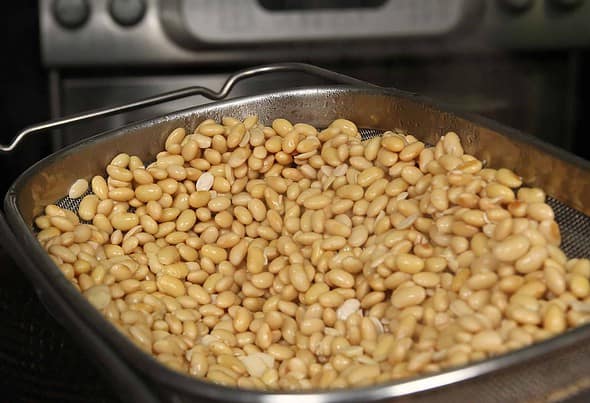
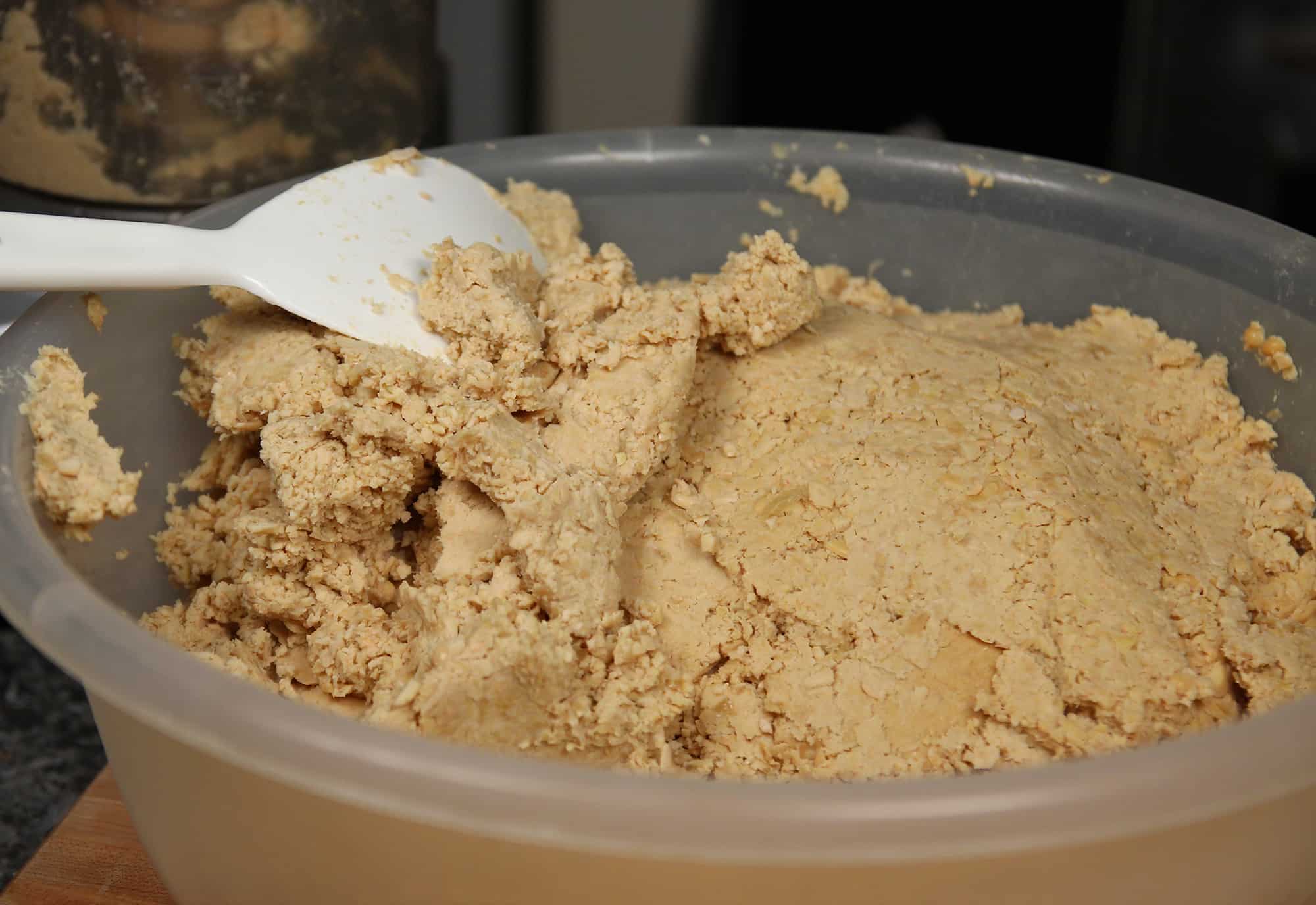
- Mash the drained beans to a paste in batches with a large mortar and pestle or in a food processor. Don’t finely grind them, leave some beans half-crushed.
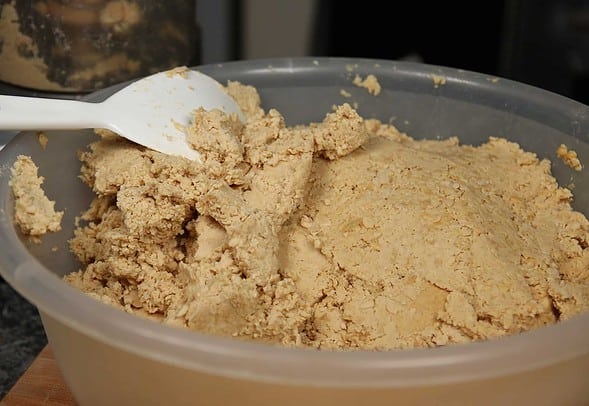

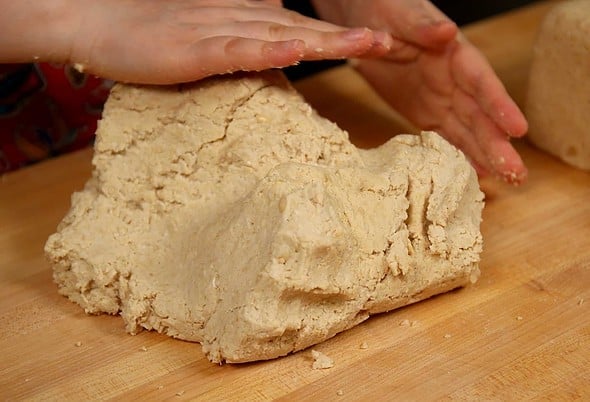
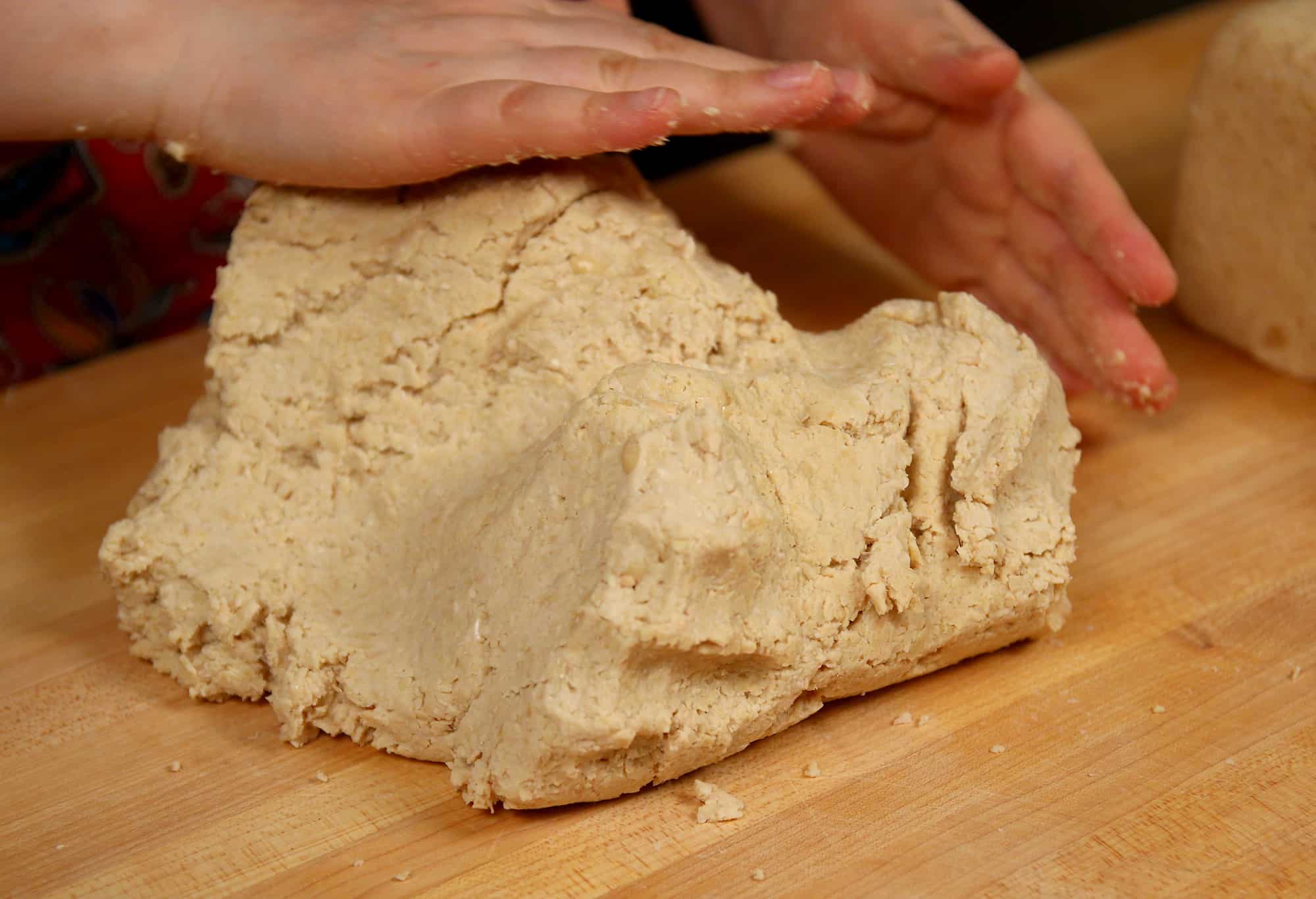
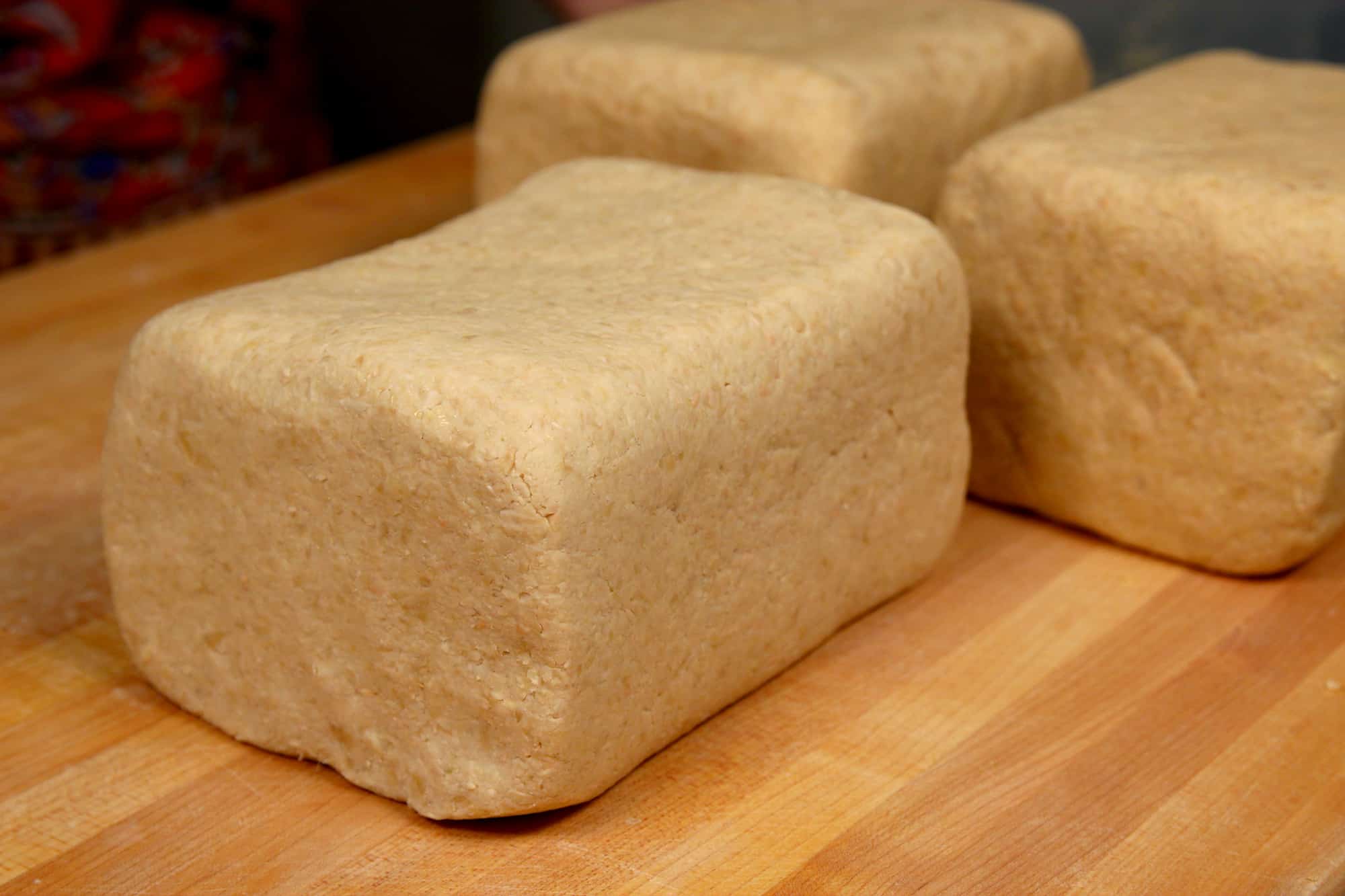
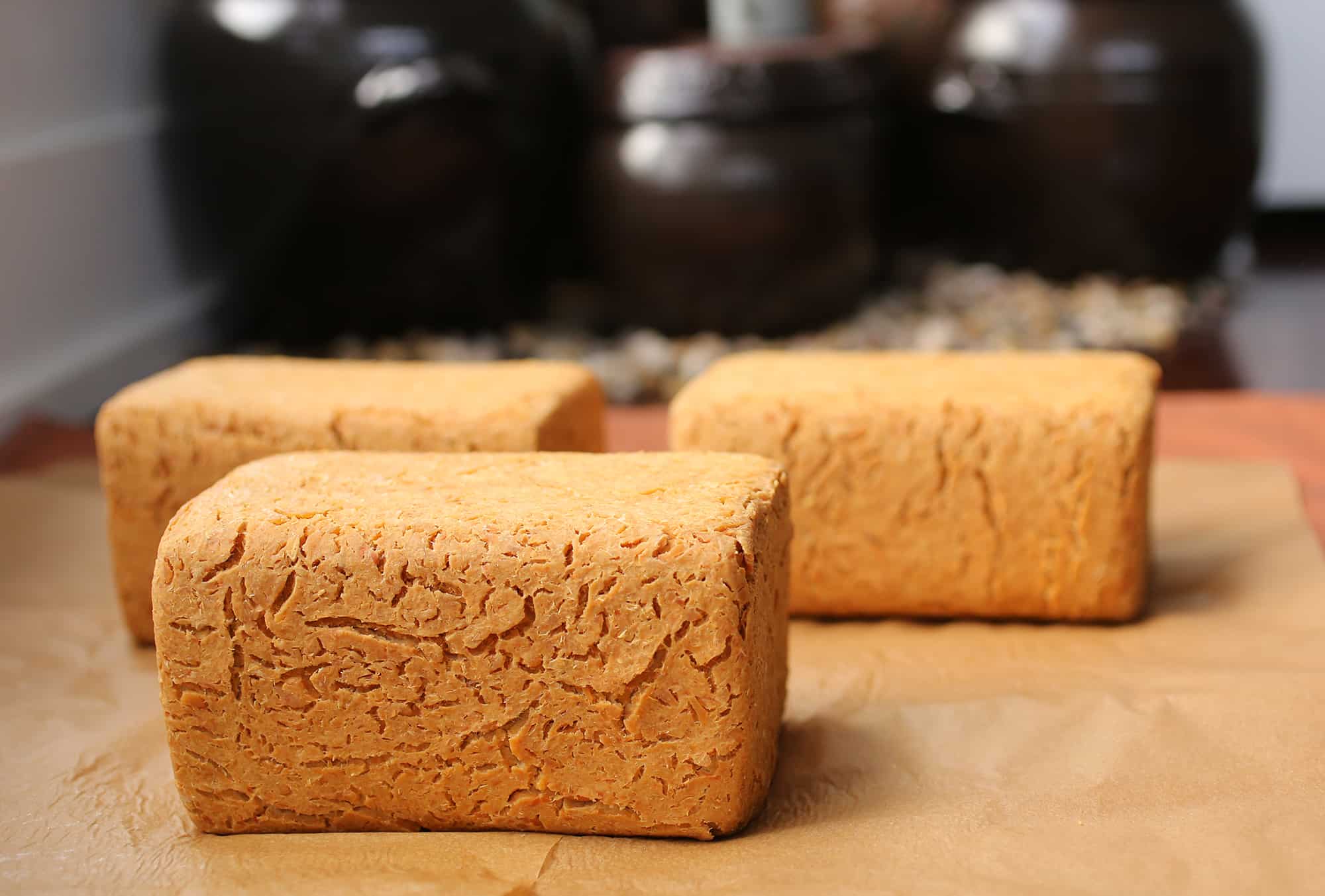
- Divide the mashed beans into 3 portions. Knead each portion with both hands and shape into a firm rectangular block measuring 6 x 3 x 4 inches.


Ferment the meju
- Traditionally Koreans dry meju on the heated ondol floors of their homes, and if you live in Korea or have that kind of heating in your house, you can do that too. But in my NYC apartment I simulate ondol by putting an electric blanket on the floor. Line the blanket with a clean cotton cloth or waxed paper and set the blocks on top, or put them in an open basket. Set the heat to low. Dry the blocks, rotating them occasionally, until they are solid enough to hang, 3 to 4 days.
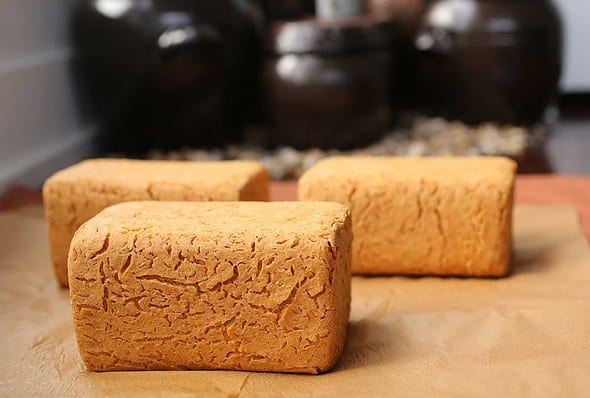

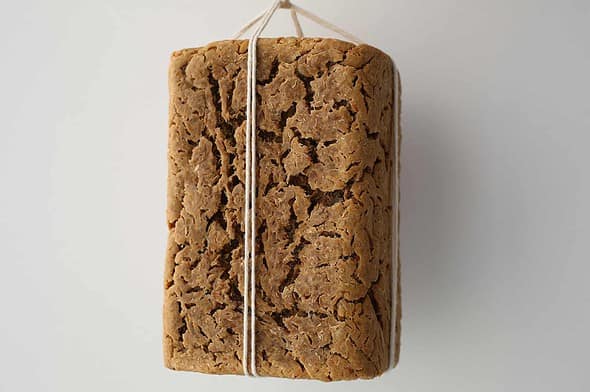
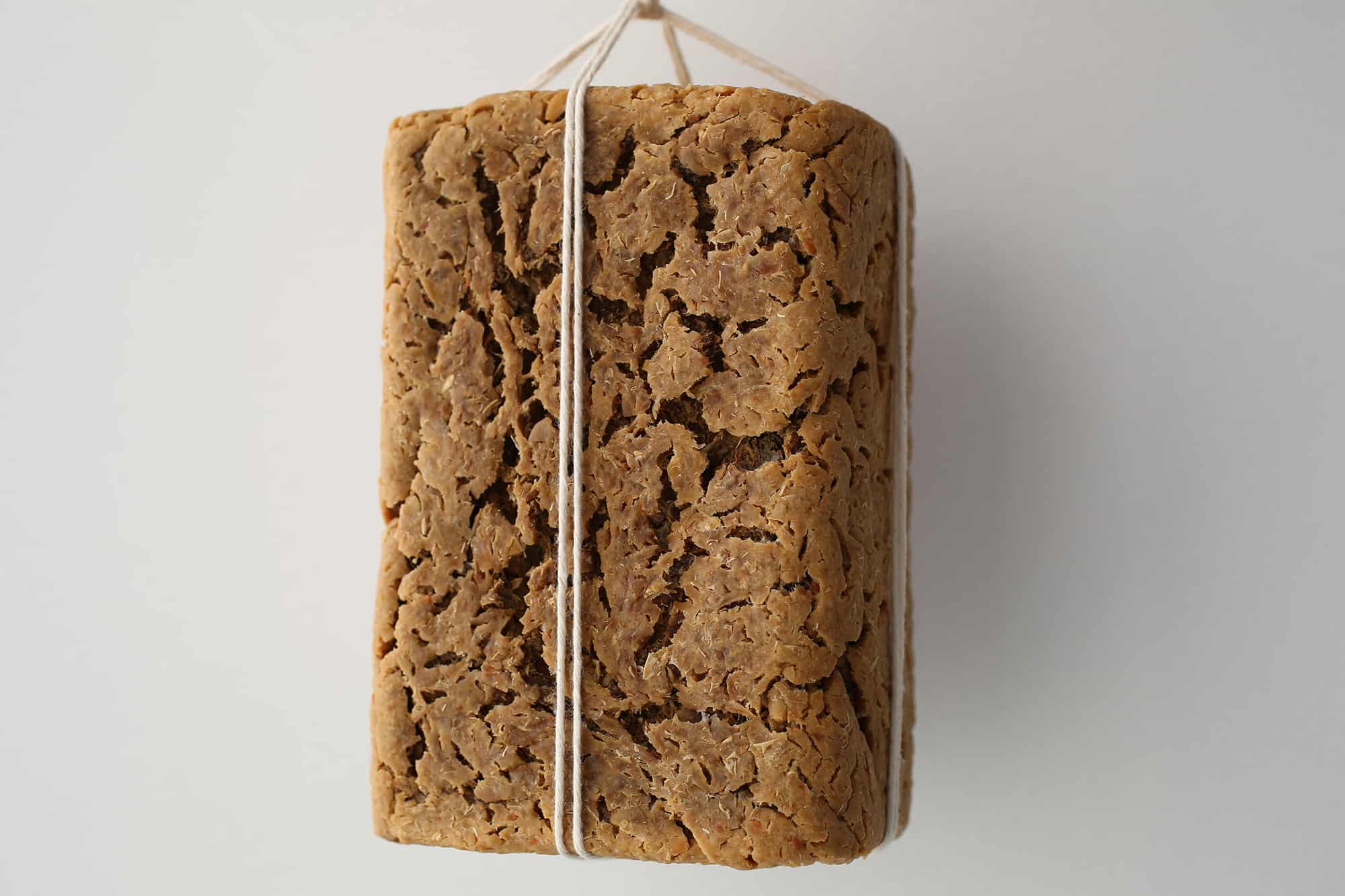
- Tie each block up in cotton twine and hang them. You can hang them outside but be sure to keep them covered and out of the rain, and if it’s too hot out they may rot. Inside, you can hang them from the ceiling with hooks. Wherever they hang, the spot should be cool and well-ventilated and all sides of the blocks should be exposed to air and not touching each other. Let the blocks hang for 6 weeks, until they are well dried out and smell a little pungent when you get your nose close to them.
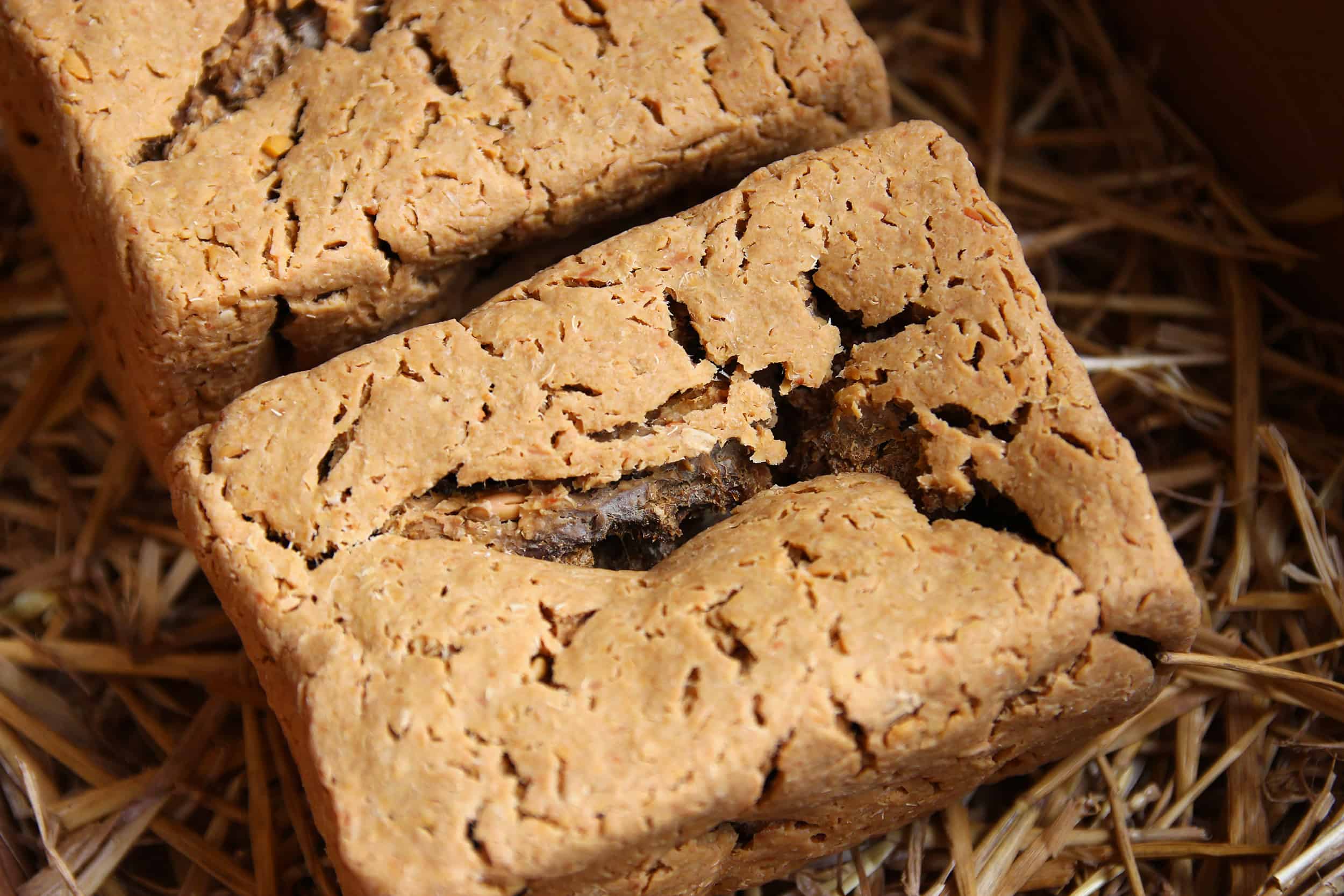
- Now it’s time to ferment the bean blocks. Place a layer of dried rice straw or hay in the bottom of a cardboard box that’s just big enough to hold the blocks with a little space between them; the straw will insulate the blocks and attract good bacteria like Bacillus subtilis in the air. (Don’t worry if you can’t find straw or hay; the blocks will still attract good bacteria.)
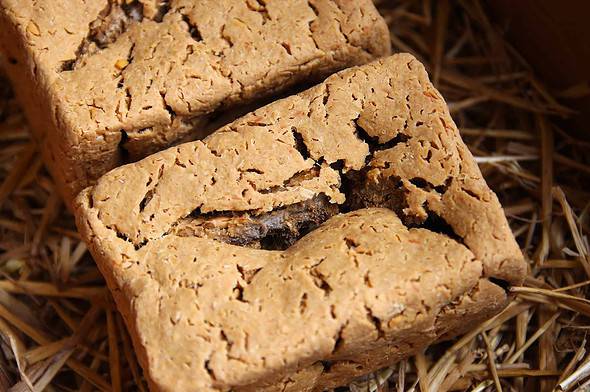
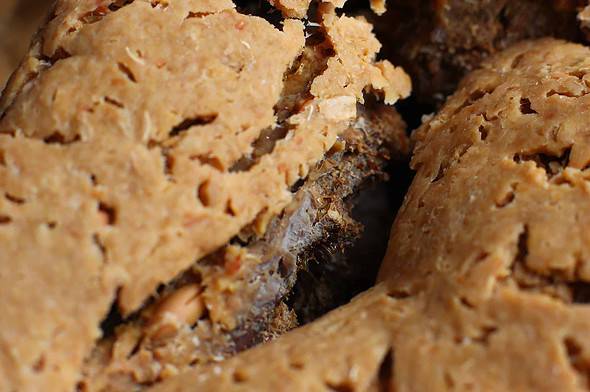
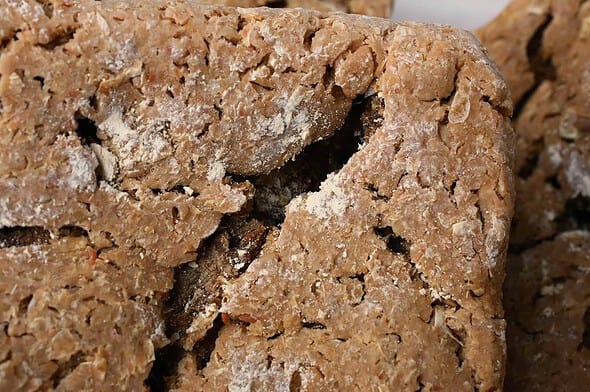
- Cover the box and put it on the electric blanket. Set the heat to low and let the bean blocks ferment for 2 weeks. At this point, the well-fermented bean blocks will smell a little earthy and pungent and will be covered with white, brownish-yellow, or sometimes greenish fungi. (These fungi change the bean proteins to peptides and amino acids, which will give the bean paste its delicious nutty flavor.)
- Tie the fermented bean blocks up in cotton twine and hang from the ceiling, as before, for 1 month.
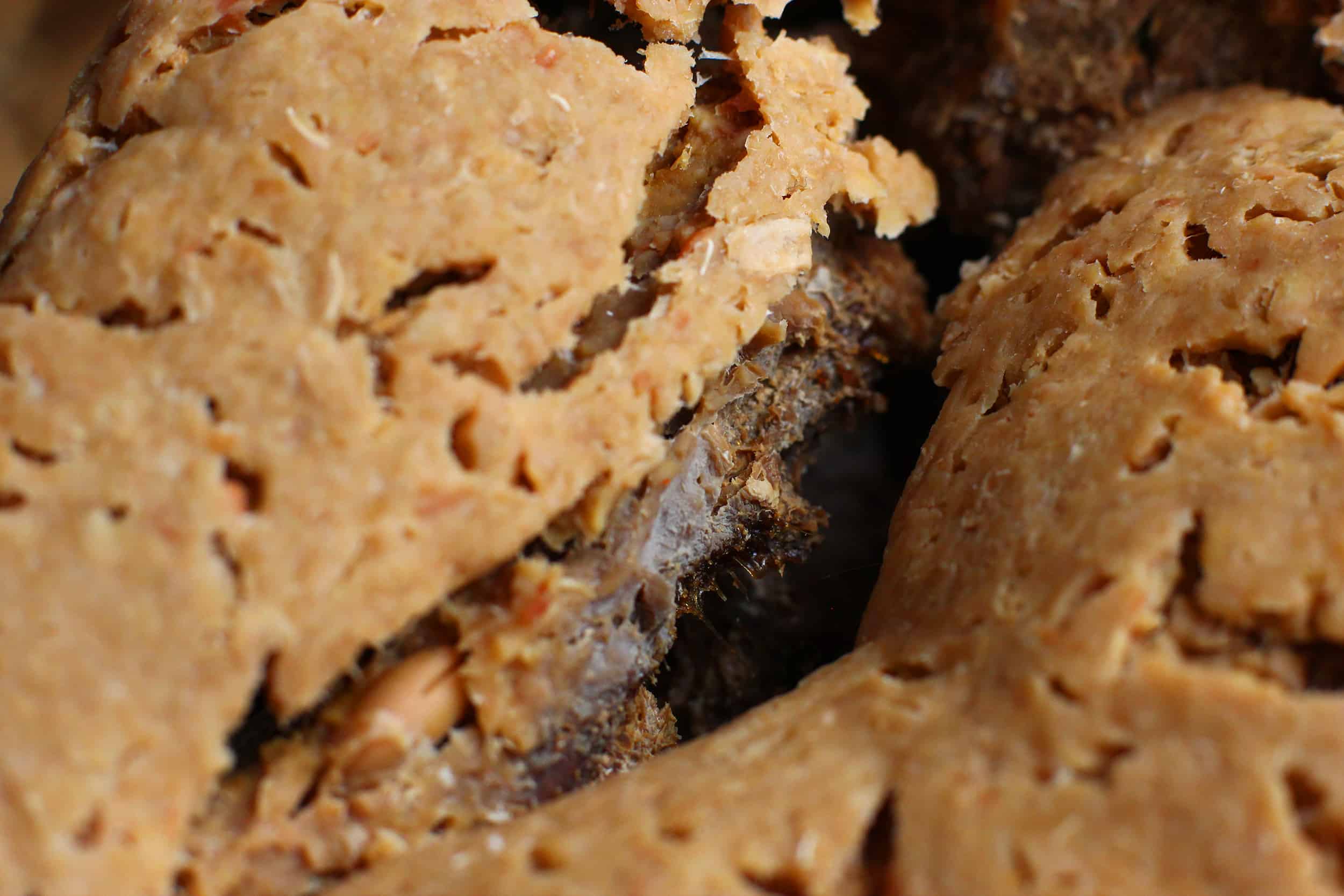

Soak the meju in brine
- Wash the blocks in cold water and to remove the fungi. Place the blocks in a shallow basket or on a baking sheet lined with waxed paper and let them dry in the sunlight for 1 day, turning them until every side of each block is dried.
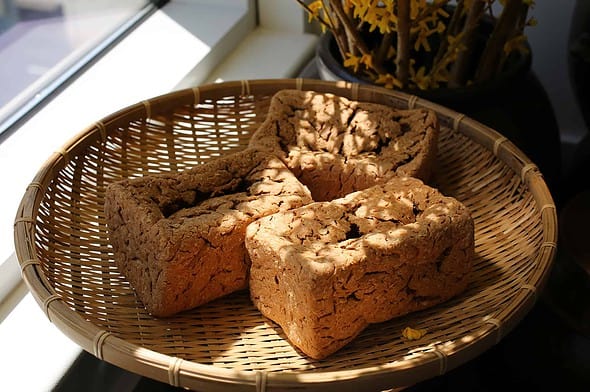
- Combine the 3½ gallons water (56 cups) and 5 quarts of the kosher salt (20 cups) in a large bowl. Stir with a wooden spoon until the salt is thoroughly dissolved.
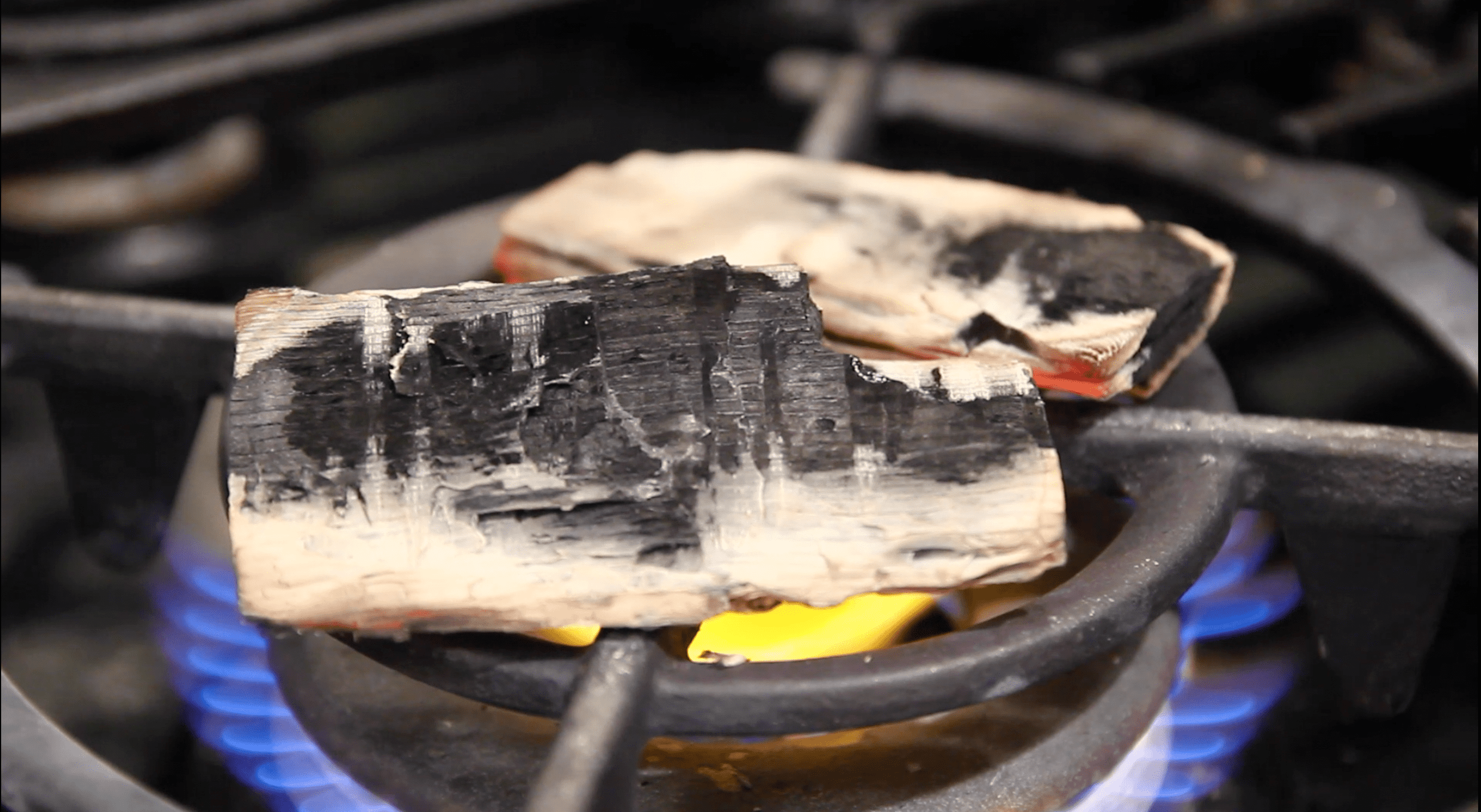
- Set out a 4- to 5-gallon earthenware crock. Put 2 pieces of the charcoal on a gas burner; turn on the flame, and heat until they are glowing red. (If you don’t have a gas burner, use the broiler: Put the charcoal pieces under the broiler and turn it on; remove the charcoal when it is red.) Use tongs to transfer the charcoal to the earthenware crock. Drizzle the honey over the burning charcoal. Cover the crock and wait for 5 minutes.
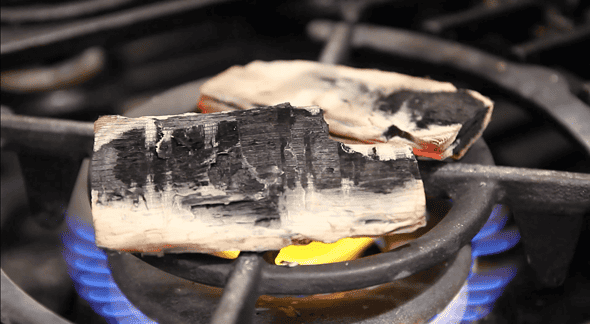

- Remove the lid. You will see lots of smoke and smell a good caramel aroma. This process sterilizes the inside of the crock and will give the sauce good flavor.
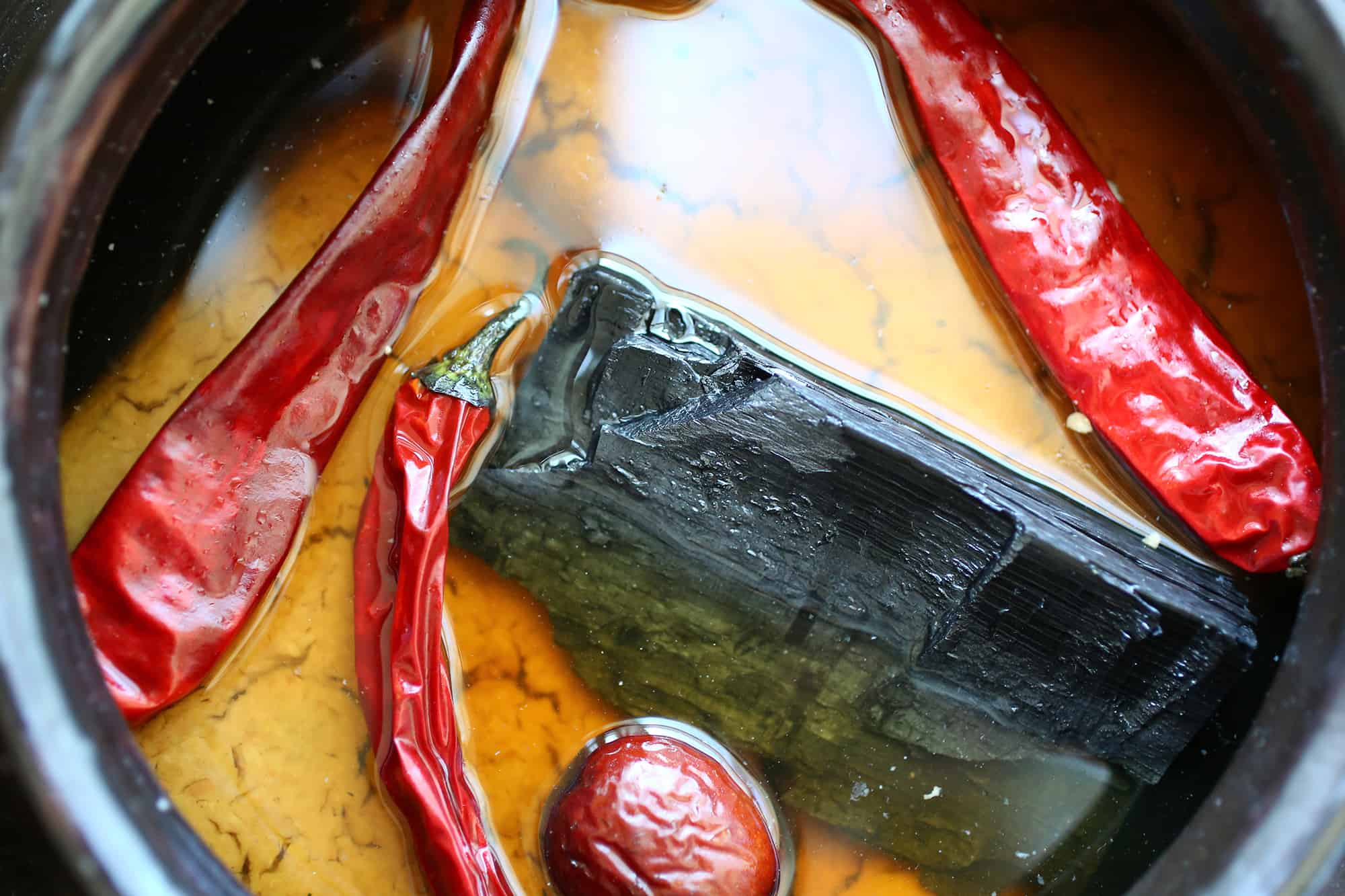
- Remove the charcoal and wipe the inside of the crock with paper towels. Add the bean blocks and salted water to the crock. Add the remaining piece of charcoal, the jujubes, and dried hot peppers; they will float on the surface of the water. (The charcoal will attract and absorb any dust. The jujubes add sweetness and the dried red peppers help prevent the blocks from going bad.) Evenly sprinkle ¼ cup salt over the tops of the meju blocks exposed to the air.
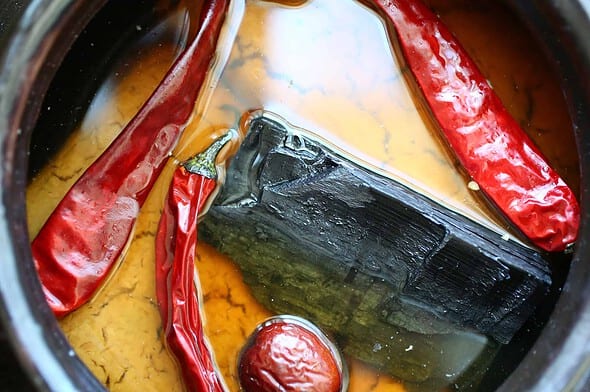
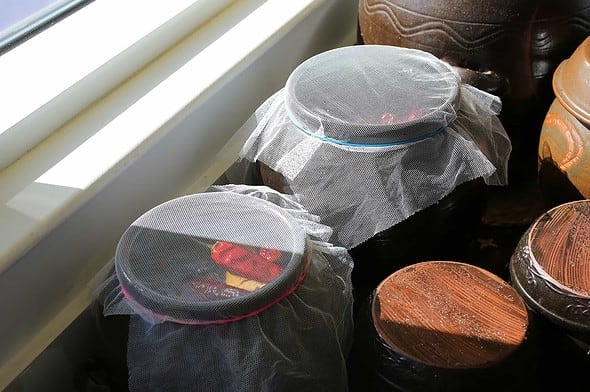
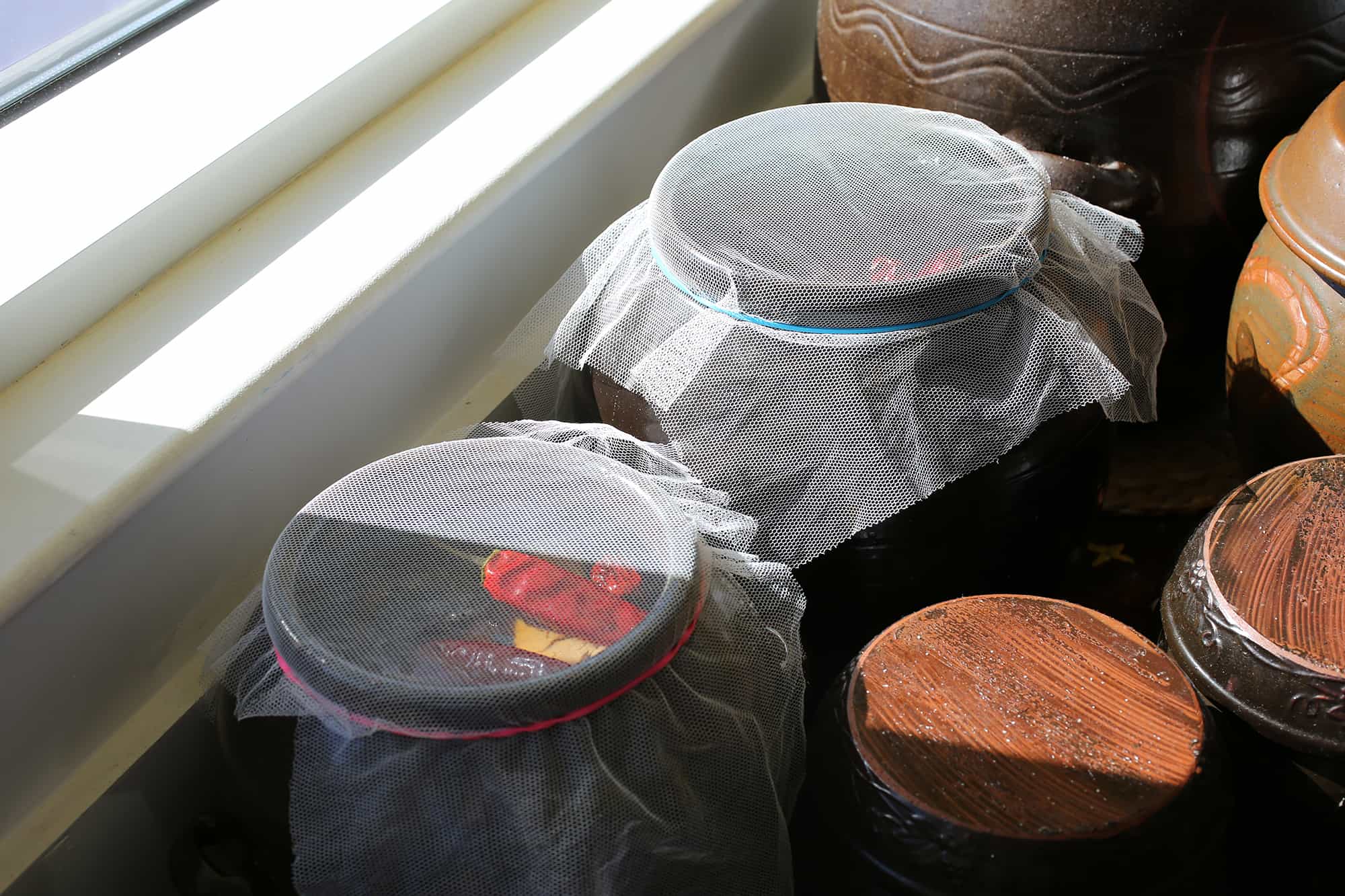
- Cover the crock with flour sacking or cheesecloth and put on the lid. Let the blocks soak in the salty water until well fermented, 2 to 3 months. On clear days remove the lid and let the crock sit in the sunlight. Close it at night and be sure to keep the crock covered with the cloth so bugs and dust can’t get in. As time passes, the salty water will turn brown and smell like deeply fermented soy sauce.
Separate the doenjang from the soy sauce
- Discard the charcoal, jujubes, and peppers. Transfer the soaked bean blocks to a large bowl. The blocks may have broken up during the soak, so use a bowl to scoop the soy sauce out of the crock and into a strainer set over another large bowl. Add any pieces of bean block to the bean block bowl. Save the soy sauce for making Korean soup soy sauce (gukganjang) later.
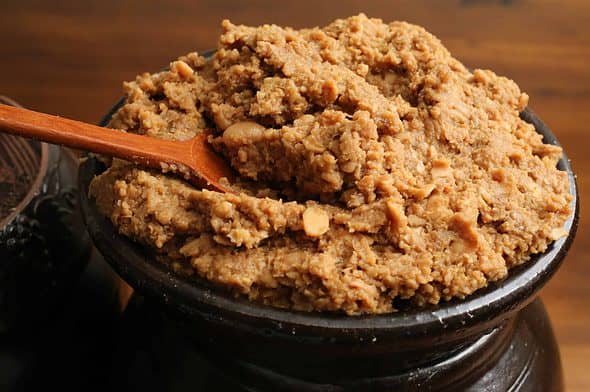
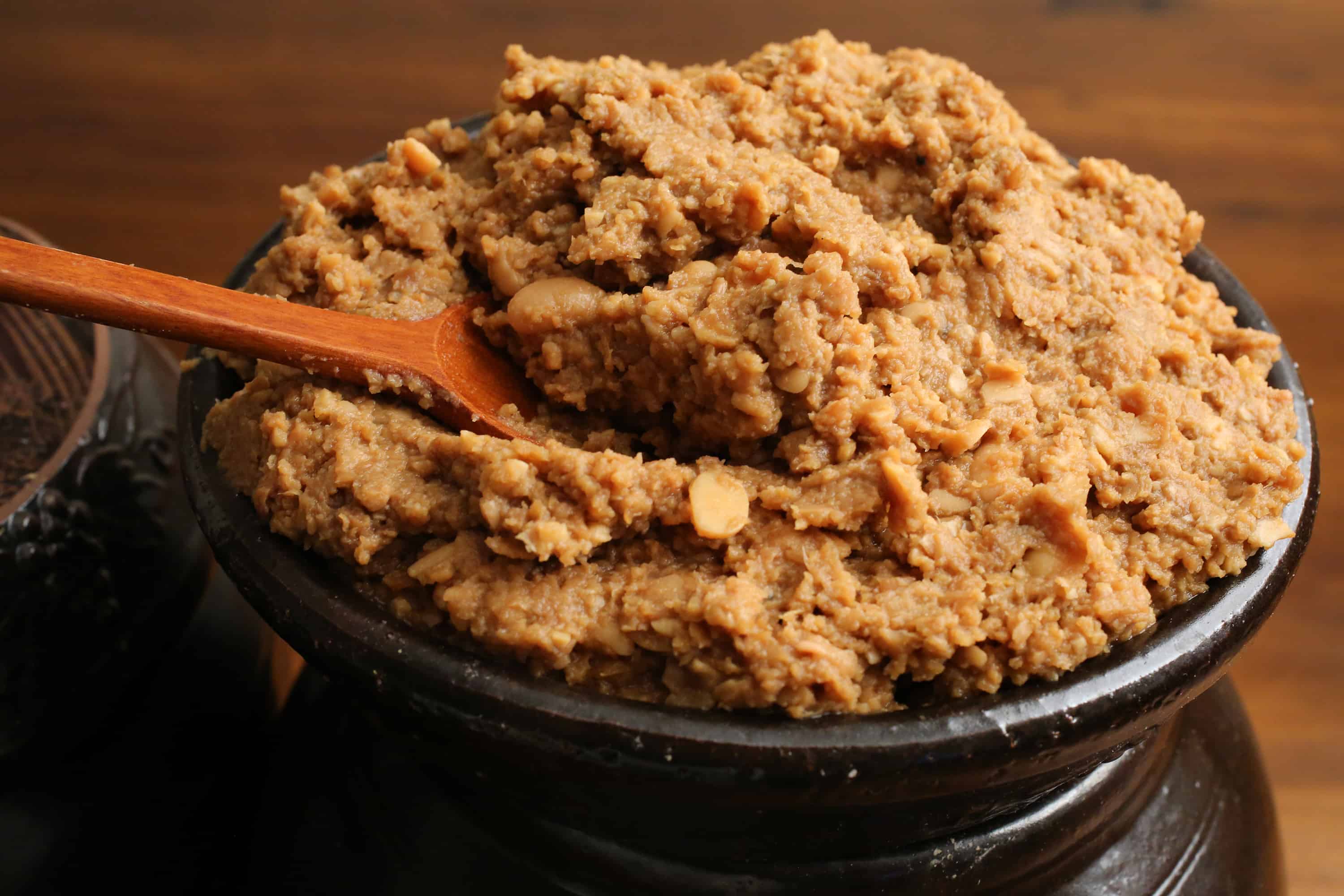
- Mix the doenjang with both hands, breaking it up into a paste, and transfer it to a 5-quart earthenware crock. Pack it down and sprinkle with the remaining ¼ cup kosher salt. Cover with the cotton cloth, secure it with a rubber band, and put on the lid.
- Put the doenjang crock in a sunny spot for its final fermentation. About twice a week on sunny days, remove the lid and let the sunlight shine into the crock through the cotton cloth. When it’s well fermented, the doenjang will smell sweet and taste salty and earthy, with a deep flavor. This will take 5 to 6 months. If it ever looks a little too dry on top, pour some of the separated soy sauce on top to make it moist again. You don’t need to stir it in.
Serving and storage
- Store the doenjang in the crock outside the house or at room temperature. Whenever you take some out, press the rest down with a spoon to keep out the air. Once in a while, take the lid off, cover with a cotton cloth, and let the sun hit it again.
Doenjang-making diary
Here’s a schedule of dates from a year of my doenjang-making. You might need to deviate from this timeline depending on how your project is going, but you get the idea of how long it takes and where you should be every month.
January 4 — Soaked the beans.
January 5 — Made the meju.
January 9 — Hung the meju up.
February 24 — Put the meju in a box with hay.
March 10 — Took the meju out of the box and hung them up.
April 10 — Washed the meju and let them dry in the sunlight.
April 11 — Soaked the meju in salty water.
June 11 — Separated doenjang and guk-ganjang.
June 22 — Made guk-ganjang.
December 1st — Doenjang was ready.
Buy this recipe's ingredients online
I really like Weee! they deliver quality packaged and fresh Korean ingredients to the continental USA. Cheaper and better than Amazon! Check them out!


Hello Maangchi,
I want to tell you that months ago, I separated my doenjang from my guk ganjang, and sterilized and canned the guk ganjang as you prescribed, and placed the solids, the doenjang, in a crock to ferment further. It has maybe been 4 months. The doenjang is amazing; umami-rich and savory. The guk ganjang not so much. It’s a little rank, very salty, and I hesitate to use it for anything, but I have a lot of it. In March, I subscribed to Kojicon, and there is access to former year’s worth of presentations (highly recommended). In the 2022 series, Irene Yoo’s process for meju indicates to ferment doenjang and gukjang SEPARATELY for ~6 mo. after separating them. I canned my guk ganjang right after separation, and it is pretty terrible. Having embarked upon several miso projects, and starting to understand the idea of Tamari, and how the Japanese (who yes, inflicted a world of pain on the Koreans in military struggles, but trying to separate that and just focus on food here) made the processes separate and created shoyu as the way to make good soy sauce, I appreciate the Korean effort to keep these two thing part of the same process – it’s more in keeping with the idea of doing these things at home. But what do you think? Might it be worth my time to take the canned guk ganjang out of it’s sterile habitat and mix with a little doenjang to get the fermentation re-started, and then let it go for 6 mo? I guess I’ve got little to lose, since I don’t really like the guk ganjang as it is.
Congratulations on your homemade doenjang turning out so well! After you remove the doenjang, leave the remaining liquid in the crock and continue to let it ferment in the sun from time to time, that’s how you’ll get delicious guk-ganjang (soup soy sauce). It takes at least six months to a year. I actually have soy sauce that has been aging in my crock for over 10 years! As time goes by, the color of the soy sauce deepens into a rich brown and the flavor becomes more complex. So, transfer the soy sauce that’s in the can into the crock and let it keep fermenting.
Hi, we are in week 3 of hanging them to dry.
I was wondering if . . .
1. The mold color and growth was okay?
2. Sometimes tiny fruit flies come, is that okay?
3. There is pinkish mold in the inside, is that okay?
The meju has fermented very well! I’ve seen many like this in the Korean countryside. All molds will be washed off later before making the sauce, so don’t worry too much. Just make sure to dry it well. I hope you end up with delicious soy sauce and soybean paste. In Korea, meju is usually made in the cold winter when there aren’t flies or other small insects around. You need to be very careful about flies.
Hi Maangchi,
My charcoal bricks dissolved in my doenjang (I forgot about my entire crock honestly) I think it’s still how it should be? It smelled very very strongly when I strained the liquid out. It’s black from the charcoal. I’m afraid to taste it. What do you think?
The charcoal should be floating, but you say it melted—so it seems you didn’t use wood charcoal.
I don’t think that soy sauce and soybean paste will be edible. I get my charcoal from a Korean grocery store. https://www.maangchi.com/ingredient/wood-charcoal
Next time you make it, be sure to go to a Korean grocery store and confirm that the charcoal is for making soy sauce and soybean paste before buying it.
I bought a thai brand of charcoal (thaan), as I couldn’t find one at my Korean grocery store. I will start anew :/ thank you for your feedback!
I’m sure your next doenjang and soy sauce will turn out great because your passion never gives up! Cheers!
Hello, Maangchi. My Meju blocks dried nicely; I turned them several times/day, and they were covered with medium-sized cracks when I hung them 9 days ago. Since that time, the cracks have become bigger, but it’s not really a problem because the blocks are getting harder as they dry out. What might be a problem is the smell. It’s not pleasant. I thought the cats had left a mouse under the furniture! When I put my nose close to the blocks, it’s not bad at the bottom, more beany, less stinky. When I sniff at the top, that’s where they smell the worst. But it’s not as bad as just catching a whiff of the aroma when I’m not expecting it. I moved them lower in the window where the tops of the blocks will catch more light, and I hope this helps! There is no visible mold, and I have not seen any fruit flies. I do a lot of fermentation, and I am used to relying on my nose to know whether things are on track, and if a wet ferment, like a kraut or a kimchi was smelling this bad, I would send it off to the compost pile! You have said this would be a pungent process; but I don’t know what that pungency is supposed to smell like. The best I can say is that this smells a little farty, a little composty. Is that normal?
The smell that comes from the drying and fermenting meju really surprises me twice. At first, I think, ‘What is that?’ and are shocked by the stinky smell, then the second surprise is, ‘Ah, my meju!’ and I smile. : ) As the meju dries completely, that smell becomes less intense. Make sure to ferment it in a well-ventilated place.
Well, here we are a few weeks later, and the smell is much changed. I am ALMOST liking it. Is it the smell that has changed or my perception? Both, maybe? The blocks are hanging in front of the widow and I can actually see light passing through some of the cracks; they run deep in the blocks! I also have acquired some rice hulls for the next step, since I don’t have rice straw. I thought about cutting some broom sedge to use, but you never know what mold or insects might wake from their winter slumber if I bring it inside – it could ruin my meju! I might wrap the blocks in cheesecloth before putting them to sleep in their heated cardboard box so that the rice hulls don’t get inside of them? When that stage is done, I plan to use the rice hulls to make a nuka pickling bed!
P.S. Thank you for mentioning me in your newsletter. It makes me feel appreciated! :-)
Hello Maangchi, I have started to make gochujang! Here is a picture of my freshly-made meju blocks. They are on top of a heat mat, the kind I use to start seeds for plants that germinate in warm soil. The soybeans came in 4lb. and 2lb. bags, so I’m working with 6lbs, and I divided the batch into 4 blocks instead of 3. As you can see, I only roughly divided the batch; they’re not all quite the same size. Probably not important?
Yes, the size of the meju doesn’t matter much. Your homemade meju blocks look beautiful, and the snow outside the window makes the scene even more special. : ) Thinking about how you soaked, boiled, and mashed the soybeans to make these meju blocks fills me with excitement too. I hope they bring you delicious soy sauce and doenjang!
Thank you, Maangchi, my fingers are crossed (but I won’t be able to keep them that way a whole year! ;-))
Hello! My meju didn’t develop any mold and I decided to proceed anyways with the brining stage. Brining is over and it smells pretty bad. I know its supposed to smell “bad” but it just smells like old musty socks mixed with pee and its sharp and not good. Is that what it’s supposed to smell like? The gukgangjang liquid is cloudy. Is it any good? Here are some pictures.
I’m not sure if this thread is still active, but please, if anyone is reading this, I could really use some help.
My Nana passed away in March of this year. Since then, I’ve been trying to take care of her two crocks of doenjang. Even though I’ve seen her do this every year for most of my life, I’m still not 100% sure I’m doing this correctly.
This recipe has been very helpful in letting me know what to expect. By the time I got the doenjang, it was already in the hangari.
I’ve been putting it out on sunny days and making sure to cover it and bring it in when it rains.
But I’m still getting large mold growths in the pots. I know I can scrape them out, but I keep having to scoop out large piles to remove all the white/green fuzzy, dusty mold. I feel like I’m wasting it.
Please, what can I do to save this? It’s the last thing she made and I would be heartbroken to lose it.
Thank you!
I’m hoping this photo will help. Today, I had to scoop out about a small bowls worth of the doenjang.
seungaseunga in reply to your question about drying the meju blocks in a dehydrator. I do the initial step after forming the blocks in an air-fryer oven with a dehydrating function to dry and firm the blocks. I do 3-4 hours at 55 degrees Celsius and turn them every 30 minutes or so (with really clean hands). I’ve made 3 batches so far and it’s worked a treat. I also place my blocks in a tiered net herb dryer instead of hanging with string as it allows brilliant air flow without letting bugs anywhere near the blocks. All the batches worked wonderfully. Hope that helps you (belatedly) and a few others too!
Hi Maangchi,
Thank you for the recipe. I tried to get my aunt to show me how to make doenjang when I was in Korea last, but my Korean is not so good and her English is non-existent, so the language barrier was too great, so it was really good to watch your video. You are a trooper to take your ganjang to a park to boil!! I used to live in NYC, so I know that was a lot to carry all that stuff out there.
Anyways, I was wondering — can the first part of drying the meju blocks be done in a dehydrator or do they really need to sit on an electric blanket and tied up to attract the initial layer of bacteria?
Thanks!