Here I’m introducing you to a Korean Chinese dish, jjampong. This noodle soup is one of the most popular dishes requested by my Youtube subscribers and blog readers.
Whenever I pronounce “jjamppong,” I think it sounds funny! “JJAM PONG!” : )
You need so many different ingredients to make good “jjamppong” as you will see in this video. It contains all the nutrients we need, so I can say a bowl of jjamppong is a wholesome, nourishing, and well balanced meal. You can skip some ingredients or replace some ingredients with ones more easily available to you.
I prepared 2 versions of jjamppong recipe here: spicy jjamppong and non-spicy jjamppong.
Pour 7 cups of water into a pot. Add 10 large dried anchovies (after removing heads and guts), a handful of dried kelp, half a medium sized onion, and 3 dried shiitake mushrooms.
Boil it for 10 minutes over high heat. Then lower the heat to low-medium and boil for 30 minutes more. Then set it aside
Second step:
make mixture of hot pepper flakes and vegetable oil
In a small bowl, mix 1½ tbs of hot pepper flakes and 1 tbs of vegetable oil.
*tip: The reason we make this mixture is to prevent the hot pepper flakes from floating in the soup when it boils. You can add or decrease the amount of hot pepper flakes and vegetable oil according to your taste.
Third step:
prepare seafood and meat
Cut squid in half lengthwise and then cut shallow the inside part of squid in a grid pattern.
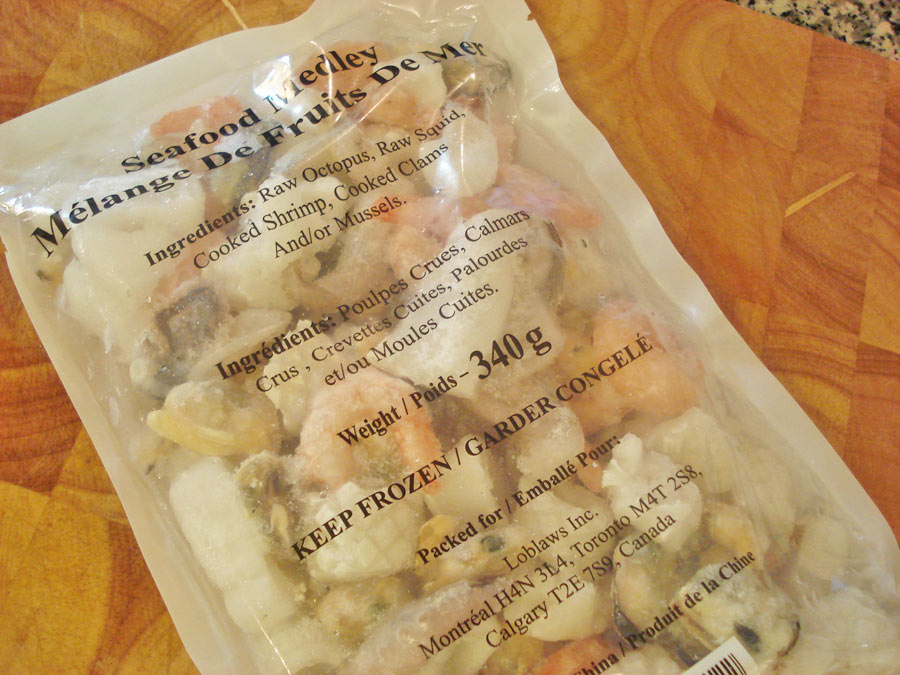
Shell 3 large shrimp and 4 mussels per serving.
Cut ¼ cup of pork into thin strips.
Fourth step:
prepare vegetables
Slice some carrot, cabbage, napa cabbage, onion, and white mushrooms into bite sized pieces.
Cut leeks and green onions into about 7 cm in length. Add some bamboo shoots.
*tip: 3-4 cups worth of vegetables are used per serving.
Fifth step:
cook noodles
Boil water in a large pot and add the noodles. Cook for a few minutes, then drain and rinse in cold water.
*tip: When you cook the noodles, take a sample to see if it’s cooked fully or not. The noodles should be soft and chewy.
Now ready to cook!
In a heated pan, drop 1 tbs of vegetable oil, 2 cloves of garlic, and 1 ts of minced ginger and stir it until its color starts to change to golden brown.
Put pork strips into the pan and stir fry it for 2 minutes.
Put in vegetables (cabbage, napa cabbage, carrot , sliced onion, green onion, leeks, white mushrooms, and a few pieces of bamboo shoots) and stir for 3-5 minutes.
Lower the heat and put the mixture of hot pepper flakes and vegetable oil into the pot. Stir it.
Put in seafood (squid, shrimp, and mussels) and keep stirring.
Pour 5-6 cups of stock into the pan and boil it for about 5 minutes.
Skim off the foam from the top with a spoon.
Add 1 tbs of fish sauce, 1 tbs of oyster sauce, and a pinch of ground black pepper.
Ready to serve!
Put some noodles in a large serving bowl and pour the soup and cooked ingredients on top of the noodles.
Serve it hot.
Enjoy!
Non-spicy jjamppong
Ingredients
A can of non-sodium chicken broth, ¼ cup of pork (cut into thin strips), 3 large shrimp, 4 mussels, squid (¼ cup), garlic, ginger, vegetable oil, oyster sauce, fish sauce, ground black pepper, onion, carrot, green onions, leeks, white mushrooms, bamboo shoots, noodles, and Asian chives.
First step:
prepare seafood and meat
Prepare seafood by cutting squid into bite sized pieces, shelling 3 large shrimp, and washing 4 mussels.
Cut pork into thin strips (¼ cup worth).
Second step:
prepare vegetables
Cut some carrot, cabbage, napa cabbage, onion, and white mushrooms into bite sized pieces.
Cut leeks, green onions, and Asian chives into pieces about 7 cm long.
*tip: use 3-4 cups of vegetables per serving
Ready to cook?
Drop 1½ tbs of vegetable oil and 2 cloves of chopped garlic and 1 ts of minced ginger into a heated pan. Stir it until it starts to go golden brown.
Put pork strips into the pan and stir fry it for 2 minutes
Put vegetables (cabbage, napa cabbage, a few sliced carrot, onion, green onions, and leeks, white mushrooms, and bamboo shoots) into the pan and stir them for 3-5 minutes.
Put seafood into the pan and stir it for 1 minute.
Pour a can of chicken broth into the pan and 2 cans of water from the can (that’s a total of 5-6 cups of liquid).
Skim off the foam from the top with a spoon.
Add 1 tbs of fish sauce and 1 tbs of oyster sauce.
Put noodles into the boiling soup and cook for a few minutes until the noodles are cooked but still soft.
Turn off the heat and add some Asian chives (1/4 cup) and a pinch of ground black pepper.
Transfer it into a large serving bowl and serve it hot.
Soak 2 shiitake mushrooms in warm water for 3-4 hours and cut them into bite size in length.
Soak 4-5 clams in cold salty water (2 cups of cold water +1 tbs salt) for at least 3-4 hours and wash them and set them aside.
Cut radish thinly into about 3×4 cm size, 0.2-0.3 cm in thickness.
Place the sliced radish (about 1 cup), the pieces of mushroom, and some kelp in a pot.
Pour 6-7 cups of water into the pot and boil it over high heat for 20 minutes.
Make maeuntang sauce:
Place 7 cloves galic, ½ medium size onion, ½ tbs ginger, 2 tbs cooking wine (or soju), 2 tbs hot pepper flakes, 1 tbs hot pepper paste, 2 tbs fish sauce in the food processor and grind it for about 1 minute.
Set it aside.
Prepare fish:
Put a red snapper on a cutting board and clean out guts, remove scales and fins. Wash it in cold water, cut it into chunks, and set it aside. *tip: to save time, you can ask your fishmonger to do this for you
Prepare 4 large shrimp: remove the heads and intestines, wash them, and set aside.
Prepare vegetables:
Clean ssukgat (edible chrysanthemum) and cut it into 7 cm long pieces.
Clean minari (water dropwort) and cut it into 7 cm long pieces.
Cut out the bottom part of enoki mushrooms and wash and split them.
Slice some green onions, 1 green chili pepper, 1 red chili pepper,
After boiling stock for 20 minutes, open the lid of the pot and take out kelp.
Place chunks of the fish, shrimp, clams in the boiling stock.
Add the maeuntang hot sauce and boil it all over medium heat for 30 minutes. *tip: It might boil over from time to time. Open the lid and remove the floating foam from the top and then close the lid halfway
Add ½ ts of salt, enoki mushrooms, minari (water dropwort) and ssukgat (garland chrysanthemum), green chili pepper, red chili pepper, and boil a few more minutes before serving.
Your maeuntang is done!
Serving:
Put some fish soup in a bowl for each person and provide each person with a bowl to collect fish bones and serve with rice and other side dishes.
Hwedupbap is one of my favorite dishes. I looove raw fish (sashimi in Japanese)!
One order of “hwedupbap” with tofu bean paste soup will be a reasonable meal because it consists of a balanced ratio of all nutrients! However, if you can’t eat raw fish, I recommend the vegetarian version of this dish using tofu.
What if you don’t have tofu? :) Oh, well! Then skip it. Mix rice and assorted fresh vegetables with my secret hot spicy sauce! One thing you can’t skip is lots of sesame oil!
Stir 1 cup of small dried anchovy in a heated pan for 1 minute.
Add 1 tbs olive oil and stir it for another minute.
Push the cooked myulchi to the edge of the pan away from the heat.
Make sauce by adding 1 or 2 tbs sugar, ½ ts minced garlic, 2 ts water, and 1/2 tbs corn syrup (optional) to the cleared spot on the pan.
Tip the pan so only the sauce is over the heat. Simmer it until the sauce looks shiny.
Mix the cooked anchovy with the sauce and turn the heat off.
Add ½ tbs sesame seeds and 1 ts of sesame seeds.
For spicy myulchi bokkeum:
Stir 1 cup of small dried anchovy in a heated pan for 1 minute.
Add 1 tbs olive oil and stir it for another minute.
Push the cooked myulchi to the edge of the pan away from the heat.
Make sauce by adding 1 tbs hot pepper paste, 1 tbs sugar , ½ ts minced garlic, 4 ts water, ½ tbs corn syrup to the cleared spot on the pan.
Tip the pan so only the sauce is over the heat and simmer until the sauce looks shiny.
Mix the cooked anchovy with the sauce and then turn the heat off.
Add 1 ts sesame oil and ½ tbs sesame seeds.
* You can keep it in the refrigerator up to 2 weeks until you finish eating it. When you eat it, put it at room temperature for a while before eating, so it can get soft.
As I mentioned, I made fried squid dish. The poor squid got caught by a Korean fisherman somewhere in the ocean in Korea and got handled mercilessly by someone and dried and came to Canada with my friend. And it had taken photo by me and posted, then got cooked!
What else can I do? It’s delicious. My friend, a Buddhist will give me a dirty look if she sees this.
“ooh, you are cruel!” One day she said, “how can people eat someone else’s flesh!”
Fried squid recipe:
Cut a dried squid into bite size with scissors and soak it in cold water for 1 hour
Beat 1 egg white until it foams and add ½ cup of starch powder, ½ cup of flour, 1 ts of salt, and ½ cup of cold water and mix it to make batter
Drain the squid and dry it with paper towel and add 2 tbs of starch powder and mix it
Pour vegetable oil in a pan and dip each piece of squid into the batter and fry it twice
* Serve with sauce (Mix 1 tbs of soy sauce and 1 tbs of vinegar)
Fried sweet potato
Slice sweet potato diagonally about ½ inch thick
Dip the piece of sweet potato into the batter and fry it
Miyuk guk is made of seaplant and is traditionally eaten on your birthday or after giving birth, but you can eat anytime you like. Miyuk is known to be rich in iodine and calcium and considered as food that helps lower cholesterol in your body.
Whenever I meet my mother, she recommends eating more “miyuk” and shows how much she enjoys it. She makes soup, salads with it. And also she wraps rice and sauce and eat it. We all believe it’s good food resource.
I used to have a stereotype about people from another culture that they wouldn’t like miyuk guk.
When I was in Korea, I had a friend Jeanne, an American nun who had been living in Korea for more than 35 years. She always told me how she loved Korea and Korea was like her hometown after living 35 years there! She loved all kinds of korean traditional food. Of course she could speak Korean just like a korean.
She said,”there is one thing I can’t like of korean food!” I asked, “What is it?” She said, “Miyuk guk”. I couldn’t help laughing because I expected some kind of weird korean food, but only miyuk guk. I was curious about why she doesn’t like it. She answered, “It’s slippery in my mouth, ooh, I don’t like the texture” I laughed again when I heard her point of view.
I hope she is doing well now. She must be living in somewhere in Chicago. I used to tease her, “Miss Jeanne, would you sit over here?” when we met a coffee shop sometime.
Soak 1 cup of dried miyuk in a big bowl for at least 30 minutes.
Drain the water from the sea plant and cut it into bite size
Place the soaked sea plant(about 4 cups) in a big pot and add 16 cups of water and boil it over high heat for 20 minutes.(later you may have to add more water if the soup is too thick)
Cut the beef brisket nto bite size pieces.
When the water starts boiling (about 20 minutes later), add the beef and 1 tbs of garlic. Boil it again for another 20 or 25 minutes over medium heat.
Add 4 or 5 tbs of fish sauce(add more or less depending on your taste) and drizzle a few drops of sesame oil before serving.
Seaplant salad (Miyuk muchim)
Ingredients:
7 cups of soaked miyuk (about 2 cups of dried seaplant)
6 tbs of soy sauce (more or less depends on your taste)
Soak 2 cups of dried sea plant (miyuk) in a bowl at least for 30 minutes and then drain the water from it.
Boil some water in a pot and add the soaked miyuk. Stir it with a spoon for 30 seconds .
Take out the seaplant and then rinse it in cold water. Drain the water out by squeezing the seaplant gently.
In a big bowl, put the seaplant and add 5 or 6 tbs of soy sauce, 4 or 5 tbs vinegar, 1 tbs of minced garlic, 1 tbs of sugar, 1 chopped green onion, and mix it up by hand.
Sprinkle some sesame seeds on the top and serve it cold.
It’s a delicious korean food that I know you will love.
When I was in America 10 years ago, I made kimbap for a potluck party. One Ukrainian lady was eating my kimbap, but peeling off the “black paper.” She thought that it was real paper, and she only wanted to eat the delicious stuff inside!
I make 2 kinds of kimbap in this video, so be sure to watch until the end for special bonus footage.
Tuna Kimbap
Ingredients:
5-6 cups cooked rice (made from 3 cups of uncooked rice)
In this video, I am going to show you how to make “jeon,” a traditional Korean food breaded with flour and eggs. There are many kinds of Jeon, but this one is made with Cod.
Ingredients:
Cod filets (400 grams), flour, olive oil, garlic, salt, ground black pepper, eggs, a red chili pepper, soy sauce, vinegar
You can use fresh or frozen cod. If it’s frozen, thaw it out in the refrigerator.
Rinse the filets in cold water and gently dry them using a paper towel or cotton cloth
Slice it thinly and put it in a bowl.
Sprinkle 1 ts of salt, 2 cloves of minced garlic, and 1 pinch of black pepper into the bowl of cod slices and gently mix it up by hand.
Pour 1 cup of flour into the bowl with the cod, and mix it quickly with your hand so that the cod is lightly breaded.
Beat 2 eggs in a small bowl and add a pinch of salt.
Add 1 chopped green onion and red chili pepper into the beaten eggs.
Heat a pan on the stove over medium high heat.
Add 1 tbs of olive oil or vegetable oil to the pan.
Piece by piece, dip your breaded cod into the beaten eggs, and then place the pieces onto the heated pan.
Lower the heat to medium and cook it.
Turn it over using a spatula or spoon.
Add more oil if needed.
On a big plate, place green lettuce on the bottom and place the cooked fish on it. Now it’s “jeon”!
Serve it with a dipping sauce.
* Dipping sauce: Mix 2 tbs of soy sauce and 1 or 2 tbs of vinegar
"Thank you so much for your advice Maangchi :D"
- Debbie in Kimchi and Kaktugi December 27, 2008
"oh its my plesure actually you are the only one which i have to thank that you show so much nice vds and with details thnks so much and wish you a very very very Happy..."
- Nishu in Black bean paste December 27, 2008
"Debbie, You can skip oysters, but if you don’t add rice flour porridge to your kimchi paste, the paste will be too thick. Then it will be difficult for you to..."
- Maangchi in Kimchi and Kaktugi December 27, 2008
"Nishu, oh, thank you very much. I am going to post the information on the forum then. Thanks a lot."
- Maangchi in Black bean paste December 27, 2008
"lilian Ph, oh, I’m sorry to hear that! Next time, use more water and cook longer. Don’t give up! : )"
- Maangchi in Rice cake (gyungdan) December 27, 2008
"pimky, mostly it’s used in side dishes such as seaplant salads, radish salads…"
- Maangchi in Apple vinegar December 27, 2008
"Hello! Maangchi, I am from Singapore, thank you so much for sharing your Korean recipes… I love love Korean food. I just have a question, I make my kimchi..."
- Debbie in Kimchi and Kaktugi December 27, 2008
"hey maangchi i am not able to send information there so i m sending here adress of korean store in New Delhi ,India {A-Mart korean grocery store} A-1 Mahipalpur..."
- Nishu in Black bean paste December 27, 2008
"i tried making it before but at the end the dough is un-cook in the middle. and it turn out hard"
- lilian Ph. in Rice cake (gyungdan) December 26, 2008
"i want to know what is the use of vinegar in korean food? for example in salad, rice???"
- pimky in Apple vinegar December 26, 2008