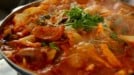


Recipes by category: pork

Tangsuyuk

Tangsuyuk is a Chinese dish which is very popular in Korea.

When I was young, this dish was always my number one choice at a Chinese restaurant. When I passed my middle school exam, my father took me and all my family members and some of his friends to celebrate it. He asked, “What would you like to eat, my smart girl? I would buy whatever you want!” I answered before he finished his sentence, “Tangsuyuk! And jjajangmyeon!” It’s very crispy fried meat in a jelly sauce and colorful vegetables, overflowing a huge plate.

I sometimes order Tangsuyuk at either a Korean restaurant or Chinese restaurant. It’s known as “sweet and sour pork” (or beef), but my satisfaction with the dish always is different.

There are 2 important factors to make this dish stand out: the crispiness of the meat and the taste of the sauce. I’m releasing a few priceless tips to all of you now!

4-6 servings
Ingredients:
600 grams (1.3 Lb) of beef, starch powder (2 cups and 2 tbs), vegetable oil, egg, Turbinado sugar 1 cup (brown or white sugar is ok too), salt, ground black pepper, 3 tbs vinegar, apple, pineapple, 5-7 wood ear mushrooms, onion, cucumber, carrot, and water

  1. Soak ¼ cup of dried wood ear mushrooms in warm water (about 5-7 mushrooms) for a few hours.
  2. To make the coating batter, mix 2 cups of starch powder (either corn starch or potato starch) with water (about 3 cups) and let it sit for a few hours until the starch sinks in the bowl. Then remove the water by pouring it into the sink.
    *tip: after draining the water, the starch will be solid and stiff.
  3. Cut beef into thin strips (5 cm long, 1 cm thick, 1 cm wide) and put it in a bowl.
  4. Add ½ ts salt and ½ ts ground black pepper to the beef and mix it well with your hand. Set it aside.
  5. Add the beef strips to the starch, and 1 egg white (or yolk) and mix it well with your hand.
  6. Heat vegetable oil in your wok and fry the beef strips for about 5 minutes until they look golden brown and crispy. It’s very important to coat the beef strips with as much starch batter as you can. Try to use all of it. Then put the fried crispy beef strips into a strainer.
    *tip: the beef strips should feel crispy through your tongs as you handle them

Next, let’s make delicious sauce!

  1. Slice ¼ medium size onion.
  2. Slice 1 or 2 apples (you can replace apples with plums).
  3. Slice carrot and cucumber thinly (several slices are needed).
  4. Drain the soaked wood ear mushrooms and cut them into bite sized bits.
  5. Cut some pineapple into chunks.
  6. Put 1/2 tbs of vegetable oil on a heated pan.  Add the sliced onion and stir it up.
  7. Add wood ear mushrooms, sliced carrot to the pan. Stir it for 1 minute.
  8. Pour 2 cups of water into the pan and boil it.
  9. When the sauce boils, add 1 ts salt, 1 ts soy sauce, 1 cup brown sugar and stir it well.
  10. Add 3-4 tbs vinegar and water starch (mixture of 2 tbs starch and 2 tbs water).
  11. Add pineapple chunks and sliced cucumber to the pan.
  12. Your sauce will look like light jelly but it will also be sizzling. Be sure to put a few drops of sesame oil in at the last minute!

Now you made your fried beef strips and sauce! If you’re waiting for your family or guests, just take a break and do the next steps just before serving.

Ok, it’s time for you to serve it now?

  1. Reheat the oil and fry the beef strips again, until each strip becomes very crispy.
  2. Put the fried beef on a large platter
  3. Reheat the sauce for a minute and pour it on top of the beef strips.
  4. Serve it hot with dipping sauce (mix 2 tbs soy sauce and 1 tbs vinegar)

Jjamppong

Here I’m introducing you to a Korean Chinese dish, jjampong. This noodle soup is one of the most popular dishes requested by my Youtube subscribers and blog readers. 

Whenever I pronounce “jjamppong,” I think it sounds funny! “JJAM PONG!”  : )

You need so many different ingredients to make good “jjamppong” as you will see in this video. It contains all the nutrients we need, so I can say a bowl of jjamppong  is a wholesome, nourishing, and well balanced meal. You can skip some ingredients or replace some ingredients with ones more easily available to you.

I prepared 2 versions of jjamppong recipe here: spicy jjamppong and non-spicy jjamppong.


Hot spicy jjamppong (1 serving)

Ingredients
Noodles for jjamppong, as well as…

for stock:
10 dried anchovies, 3 shiitake mushrooms, a handful of dried kelp (1/3 cup), half a medium size onion

meat and seafood:
¼ cup of pork, 3 large shrimp, 4 mussels, a few pieces of squid

vegetables and seasoning:
garlic, ginger, vegetable oil, oyster sauce, fish sauce, hot pepper flakes, ground black pepper, onion, carrot, green onions, leeks, white mushrooms, bamboo shoots.

Let’s start!

First step:
make stock

  1. Pour 7 cups of water into a pot. Add 10 large dried anchovies (after removing heads and guts), a handful of dried kelp, half a medium sized onion, and 3 dried shiitake mushrooms.
  2. Boil it for 10 minutes over high heat. Then lower the heat to low-medium and boil for 30 minutes more. Then set it aside

Second step:
make mixture of hot pepper flakes and vegetable oil

In a small bowl, mix 1½ tbs of hot pepper flakes and 1 tbs of vegetable oil.

*tip: The reason we make this mixture is to prevent the hot pepper flakes from floating in the soup when it boils. You can add or decrease the amount of hot pepper flakes and vegetable oil according to your taste.

Third step:
prepare seafood and meat

  1. Cut squid in half lengthwise and then cut shallow the inside part of squid in a grid pattern.
  2. Shell 3 large shrimp and 4 mussels per serving.
  3. Cut ¼ cup of pork into thin strips.

Fourth step:
prepare vegetables

  1. Slice some carrot, cabbage, napa cabbage, onion, and white mushrooms into bite sized pieces.
  2. Cut leeks and green onions into about 7 cm in length. Add some bamboo shoots.

*tip: 3-4 cups worth of vegetables are used per serving.

Fifth step:
cook noodles

Boil water in a large pot and add the noodles. Cook for a few minutes, then drain and rinse in cold water.

*tip: When you cook the noodles, take a sample to see if it’s cooked fully or not. The noodles should be soft and chewy.

Now ready to cook!

  1. In a heated pan, drop 1 tbs of vegetable oil, 2 cloves of garlic, and 1 ts of minced ginger and stir it until its color starts to change to golden brown.
  2. Put pork strips into the pan and stir fry it for 2 minutes.
  3. Put in vegetables (cabbage, napa cabbage, carrot , sliced onion, green onion, leeks, white mushrooms, and a few pieces of bamboo shoots) and stir for 3-5 minutes.
  4. Lower the heat and put the mixture of hot pepper flakes and vegetable oil into the pot. Stir it.
  5. Put in seafood (squid, shrimp, and mussels) and keep stirring.
  6. Pour 5-6 cups of stock into the pan and boil it for about 5 minutes.
  7. Skim off the foam from the top with a spoon.
  8. Add 1 tbs of fish sauce, 1 tbs of oyster sauce, and a pinch of ground black pepper.

Ready to serve!

Put some noodles in a large serving bowl and pour the soup and cooked ingredients on top of the noodles.

Serve it hot.

Enjoy!


Non-spicy jjamppong

Ingredients
A can of non-sodium chicken broth, ¼ cup of pork (cut into thin strips), 3 large shrimp, 4 mussels, squid (¼ cup),  garlic, ginger, vegetable oil, oyster sauce, fish sauce, ground black pepper, onion, carrot, green onions, leeks, white mushrooms, bamboo shoots, noodles, and Asian chives.

First step:
prepare seafood and meat

  1. Prepare seafood by cutting squid into bite sized pieces, shelling 3 large shrimp, and washing 4 mussels.
  2. Cut pork into thin strips (¼ cup worth).

Second step:
prepare vegetables

  1. Cut some carrot, cabbage, napa cabbage, onion, and white mushrooms into bite sized pieces.
  2. Cut leeks, green onions, and Asian chives into pieces about 7 cm long.

*tip: use 3-4 cups of vegetables per serving

Ready to cook?

  1. Drop 1½ tbs of vegetable oil and 2 cloves of chopped garlic and 1 ts of minced ginger into a heated pan. Stir it until it starts to go golden brown.
  2. Put pork strips into the pan and stir fry it for 2 minutes
  3. Put vegetables (cabbage, napa cabbage, a few sliced carrot, onion, green onions, and leeks, white mushrooms, and bamboo shoots) into the pan and stir them for 3-5 minutes.
  4. Put seafood into the pan and stir it for 1 minute.
  5. Pour a can of chicken broth into the pan and 2 cans of water from the can (that’s a total of 5-6 cups of liquid).
  6. Skim off the foam from the top with a spoon.
  7. Add 1 tbs of fish sauce and 1 tbs of oyster sauce.
  8. Put noodles into the boiling soup and cook for a few minutes until the noodles are cooked but still soft.
  9. Turn off the heat and add some Asian chives (1/4 cup) and a pinch of ground black pepper.
  10. Transfer it into a large serving bowl and serve it hot.

Mandu (dumplings)

Ingredients:

Make filling:

  1. Place 1 cup of ground pork and 2 cups of ground beef into a big bowl.
  2. Add 1 ts of salt, 1 tbs of sesame oil, ½ ts of ground pepper and mix it by hand and push the mixture of meat on the side of the bowl.
  3. Wash asian chives (bu chu), dry well with paper towel or cotton cloth and then chop them to make 2 cups. Add 1 tbs of oil and mix it up. Place it in the big bowl next to the ground meat.
    tip: oil will coat vegetables so that liquid would not come out from it
  4. Chop 4-5 soaked shiitake mushrooms and half an onion and put it into a small bowl.
  5. Add 1 ts of soy sauce, 1 ts of sugar, and 2 ts of sesame oil the small bowl in the last step. Mix it by hand and then transfer it to the big bowl.
  6. Squeeze half a package of tofu using cotton cloth or paper towel and put it into a small bowl. Then add a pinch of salt, 1 ts of sesame oil and mix it and put it next to chopped chives.
  7. In the big bowl, add 3 cloves of minced garlic and mix all ingredients by hand.


Make Mandu:

For fried mandu:

  1. Place one mandu skin on your left hand and put some filling mixture on the center of the skin.
  2. On the half of the edge of the skin, put a little cold water with your fingertips.
  3. Fold skin in half over filling and press edges together to make ripple shape.
  4. Place some vegetable oil on heated pan and add mandu.
  5. Lower the heat over low medium and cover the lid of the pan to cook.
  6. A few minutes later, open the lid and turn over each mandu. Place 2-3 tbs of water and cover the lid. Cook a few minutes more over low heat.
  7. When the mandu is golden brown, transfer it to a plate.
  8. Serve hot with dipping sauce (equal parts vinegar and soy sauce).

For mandu soup:

  1. In a pot, place 6 cups of water, 8 dried anchovies, the leftover shiitake mushroom stems, left over onion and boil it all over medium heat for 20-30 minutes. If water evaporates, you can add more water.
  2. When the stock is well made, remove the anchovies and onion.
  3. Add 1 ts of fish sauce, 2 cloves of minced garlic and your mandu and cover the lid. (you can add more salt if you want)
  4. When mandu cooks properly, it floats to the surface.
  5. Add 1 beaten egg, 2 sliced green onions: Done!
  6. Serve hot with a bowl of kimchi. (ground pepper is optional)

Kimchi stew (kimchi chigae) and soybean sprout side dish (kongnamool)

Kimchi stew is one of Koreans’ most favorite dishes all the year around. When you eat kimchi stew with rice, you won’t need any other side dishes. You can replace pork with a can of tuna or even 2 cans of tuna. : )

Ingredients:

Ok, let’s start!

  1. In a shallow pot, put some chopped kimchi and juice.
  2. Add sliced onion, hot pepper paste, and hot pepper flakes, sugar, and green onions.
  3. Pour water until all ingredients are submerged.
  4. Close the lid of the pot and boil it 25 or 30 minutes. (first 10 minutes will be high heat and then turn down the heat over medium heat)
  5. Add some tofu and boil it 5 minutes more and put some sesame oil right before serving.

soybean sprouts side dish (kongnamul muchim)

Ingredients:

  1. Rinse and drain a package of soybean sprouts a few times over. Pick out any rotten sprouts.
  2. Put the soybean sprouts into a pot.
  3. Add 2 ts of salt and 1 cup of water. Close the lid.
  4. Bring to a boil over high heat, and boil for 15 minutes.
  5. Drain the cooked soybean sprouts and let them cool down.
  6. Put the soybean sprouts in a large bowl with 2 cloves of minced garlic, 2 chopped green onions,1 tbs of soy sauce, 1 ts of salt, ½ ts of sugar, 1 tbs of sesame oil, and ½ -1 ts of hot pepper flakes (optional). Mix it by hand.
  7. Transfer it onto a plate and sprinkle some roasted sesame seeds over top.

Enjoy it!

Jjajangmyun (blackbean noodles)

Let me introduce you to jjajangmyun. I realized recently why so many people have requested this dish. One of my youtube commenters from Hong Kong said she has seen Koreans eating jjajangmyun very often in a Korean drama. She said the noodles looked very delicious. I was not surprised at her comment because food has a very close connection with culture.

Korean dramas are popular in other Asian countries which are not only stories but also all kinds of things such as food, fashion, and style of make up.

Jjajangmyun is everybody’s favorite food. When I was young, one plate of jja jang myun from a Chinese restaurant always made me excited. We usually order Jja jang myun from a Chinese restaurant and a delivery man brings noodles contained in a specially made tin box in 30 minutes.

I usually ended up covered in jjajang sauce and my mom gave me a Kleenex!

Ingredients:
Noodles (special “myun” for jjajangmyun), black bean paste, half pound of pork belly, sugar, olive oil, potato starch powder, sesame oil, Asian radish, potato, zucchini, onion, cucumber.

Makes 4 servings.

  1. Cut the of pork into ½ inch (1cm) cubes. Leave the skin on.
  2. Add  ½ tbs of olie oil to a heated wok. When that’s hot, add the pork and stir fry it until it looks crispy.
  3. When the pork is well cooked and the color turns golden brown, drain all the hot fat and set the pork aside. Leave it in the wok, we’re going to use this later.
  4. Preheat a small skillet over medium heat with 2 tbs of vegetable oil. When that’s hot, add 7 tbs of black bean paste and stir fry for 1 minute.
  5. Remove the extra oil and set the black bean paste aside.

Cut all vegetables into 0.5 inch cubes and place them on a big plate or tray. You will end up with 1 cup of radish, 1 cup of potato, 1 cup of zucchini, and 2 cups of onion.

  1. Reheat the crispy pork in your wok over high heat, and add 1 tbs of olive oil.
  2. Add radish and potato and saute them for 2 minutes. Then add zucchini and onion and saute them for another 2 minutes.
  3. Add 3 cups of water until all the ingredients are submerged, and close the lid and boil it for 15-20 minutes.
  4. Open the lid of the wok and skim off the foam from the surface. Add the fried black bean paste from the small skillet and stir it up.
    *tip: to check if ingredients are cooked or not, try a sample potato chunk. It should be cooked, not raw.
  5. Mix 2-3 tbs potato starch powder (or corn starch) and 2 tbs water and add it into the boiling soup and stir it. Then the soup will turn into a sticky sauce.
    YOU MADE JJAJANG SAUCE!

Now, let’s cook the noodles (“myun”)

For 2 servings, you will need one bunch of noodles from the package.

  1. Boil water in a big pot, add the noodles and close the lid. Cook for a few minutes according to the direction on the package (around 3 minutes).
  2. Try one sample noodle to check if it’s cooked properly or not. It should be soft and not stiff at all. If it’s cooked, drain the noodles and place them on a large plate or bowl.
  3. Reheat the jjajang sauce and put it on the noodles

Serving:
Don’t eat it cold : )

Garnish with cucumber strips on the top of jjajang sauce and serve it with kimchi or yellow pickled radish.

Recent Comments:

  • "Debbie, You can skip oysters, but if you don’t add rice flour porridge to your kimchi paste, the paste will be too thick. Then it will be difficult for you to..."
    - Maangchi in Kimchi and Kaktugi
    December 27, 2008
  • "Nishu, oh, thank you very much. I am going to post the information on the forum then. Thanks a lot."
    - Maangchi in Black bean paste
    December 27, 2008
  • "Dominique, Yes, you can use chicken or anchovy stock instead of beef. If you like milky color soup, do this way. In a..."
    - Maangchi in Seaplant soup (miyuk guk) and seaplant salad (miyuk muchim)
    December 27, 2008
  • "lilian Ph, oh, I’m sorry to hear that! Next time, use more water and cook longer. Don’t give up! : )"
    - Maangchi in Rice cake (gyungdan)
    December 27, 2008
  • "pimky, mostly it’s used in side dishes such as seaplant salads, radish salads…"
    - Maangchi in Apple vinegar
    December 27, 2008
  • "Hello! Maangchi, I am from Singapore, thank you so much for sharing your Korean recipes… I love love Korean food. I just have a question, I make my kimchi..."
    - Debbie in Kimchi and Kaktugi
    December 27, 2008
  • "hey maangchi i am not able to send information there so i m sending here adress of korean store in New Delhi ,India {A-Mart korean grocery store} A-1 Mahipalpur..."
    - Nishu in Black bean paste
    December 27, 2008
  • "Hi Maanchi, Thankyou for your delicious receipe! I’ve made seaweed soup so many time but this was the first time it..."
    - Dominique in Seaplant soup (miyuk guk) and seaplant salad (miyuk muchim)
    December 27, 2008
  • "i tried making it before but at the end the dough is un-cook in the middle. and it turn out hard"
    - lilian Ph. in Rice cake (gyungdan)
    December 26, 2008
  • "i want to know what is the use of vinegar in korean food? for example in salad, rice???"
    - pimky in Apple vinegar
    December 26, 2008
  • "Thank you Maangchi"
    - HangukSarang in Black bean paste
    December 26, 2008
  • "Of course food is the same, but the recipes are a little different by regions."
    - Maangchi in Maangchi came back home
    December 26, 2008

Recent discussions:

These are photos sent to me by readers who cooked my recipes. Send me a photo of the food you make and I will put it here. You can see more photos on my photos page.

Arianna Wasserburger's dakkangjung (sweet and crispy chicken)Amy King's mandujenny's hobakjuk (butternut squash or sweet pumpkin porridge)Aga Suka's galbijjimFrank Seo's chiken dish (dakkangjung)Megan Carroll's  Korean dishesiJessica's Korean dishesQiu's butternut squash porridgeAmy's dakkangjungSirena Tse's kimchiSirena's kongjang (soybean side dish)Anne Marit Vik's bibimbap

Bloggers who made my recipes

maangchi.com page views:

website stats