


Kimchi is a staple of Korean life and many Koreans include it in their meals three times a day. You can eat it by itself, or use it in so many different Korean recipes. When Koreans make kimchi, they make an effort to make the best kimchi possible and include many regional ingredients.
Today I will show you how to make a traditional-style kimchi with oysters, and we’ll also make radish kimchi (“kkakdugi”) with the same kimchi paste, which saves us from having to make these two kinds of kimchi separately. This is how I make kimchi and kkaktugi, because I need both in my house, but you might be interested in my “easy kimchi” (mak kimchi) recipe if you don’t have a lot of time, or in my kakdugi recipe if you want to make only kakdugi, or make my traditional napa cabbage kimchi recipe by itself if that’s all you need. Also, if you don’t like oysters, you can leave them out.
Many people think you have to wait for kimchi to be fermented before eating, but personally I prefer to eat fresh kimchi, as soon as I make it. And I like to make stew (kimchi-jjigae) out of older kimchi.
Ingredients
- 2 large size napa cabbages (about 8 pounds: 3.6 kg) and 2 Korean radishes (about 4-5 pounds: 2 kg)
- 1½ cup of kosher salt
- ½ cup sweet rice flour, ¼ cup sugar, water
- 4 cups of Korean hot pepper flakes (gochugaru)
- 1 cup fish sauce,
- 1 medium sized onion, minced (about 1 cup)
- 1 cup of fresh garlic, minced
- 1 tbs minced ginger
- 7 stalks of green onions, chopped diagonally
- 2 cups worth Buchu (Asian chives), chopped,
- 2 cups of matchstick-cut radish
- fresh oysters (optional)
Directions
- Cut the cabbages in half, and then slit each half through the core, but not through the rest of the leaves.
- Soak each piece in cold water and sprinkle salt over the each leaf , and then set it aside for 2 hours.
*tip: the stems should get more salt than the leaves - Peel 2 kg of Korean radishes and cut them into 1 inch cubes. Do this by cutting them into several disks, and then cutting horizontally, and then vertically. Put them in a big bowl and sprinkle them with ¼ cup of kosher salt. Then set these aside, too.
- 2 hours later, turn the pieces of cabbage over so they get salted evenly. Turn the radishes as well.
- Another 2 hours later, you will see the cabbage look softer than before, and it should have shrunk.
*the total salting process will take 4 hours - Rinse the salted cabbage and radish with cold water 3 times.
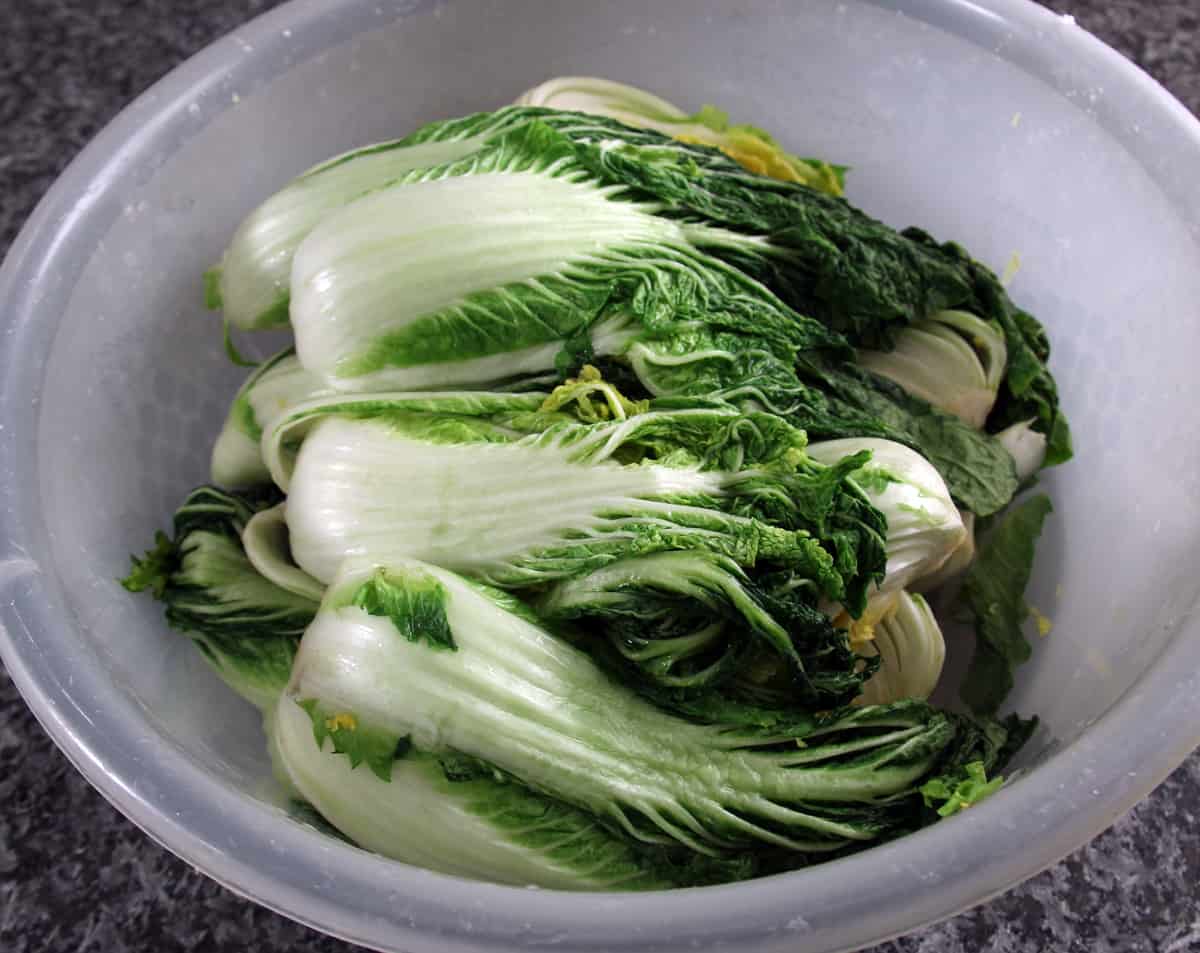
Making Kimchi paste:
Make porridge
- Put ½ cup of sweet rice flour and 3 cups of water into a skillet and mix them up. Then cook over medium-high heat, stirring constantly.
- When you see some bubbles, pour ¼ cup of sugar into the porridge and stir one more minute. Then cool it down.
- Place the cold porridge into a big bowl. Now you will add all your ingredients one by one.
- Add fish sauce, hot pepper flakes, crushed garlic, ginger, and onion
*tip: it’s much easier to use a food processor. - Add green onions, Asian chives, and radish.
- Add 2 cups of frozen oysters, but this is optional. (I found out lots of people can’t eat them.)
- Mix all ingredients well.
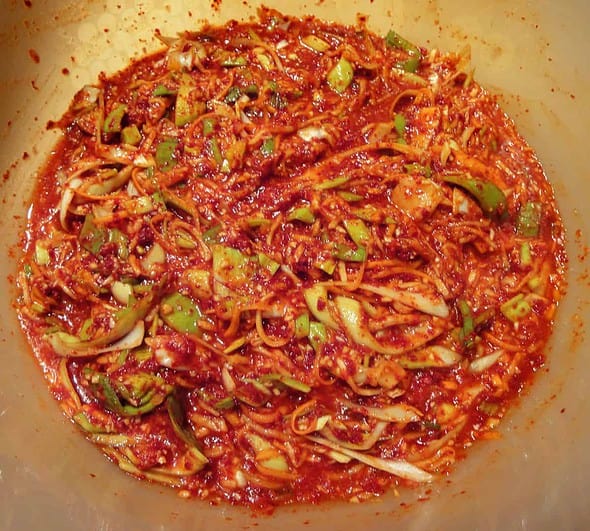

Are you ready to spread our paste on the leaves and make your kaktugi?
* I recommend you wear rubber gloves so that you don’t irritate your skin.
- Spread the kimchi paste onto each leaf of the cabbage, and make a good shape out of the leaves by slightly pressing with both hands.
- Put it into an air- tight sealed plastic container or glass jar.
- Mix your leftover paste with your radish cubes to make kkakdugi.
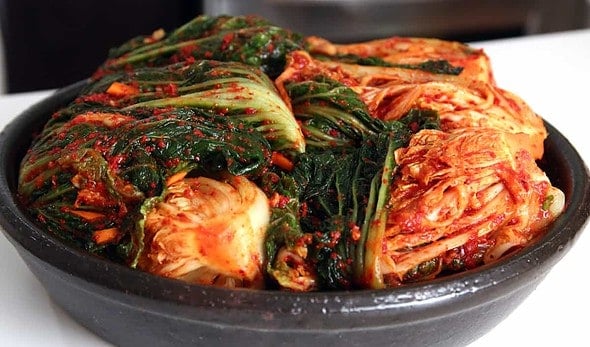

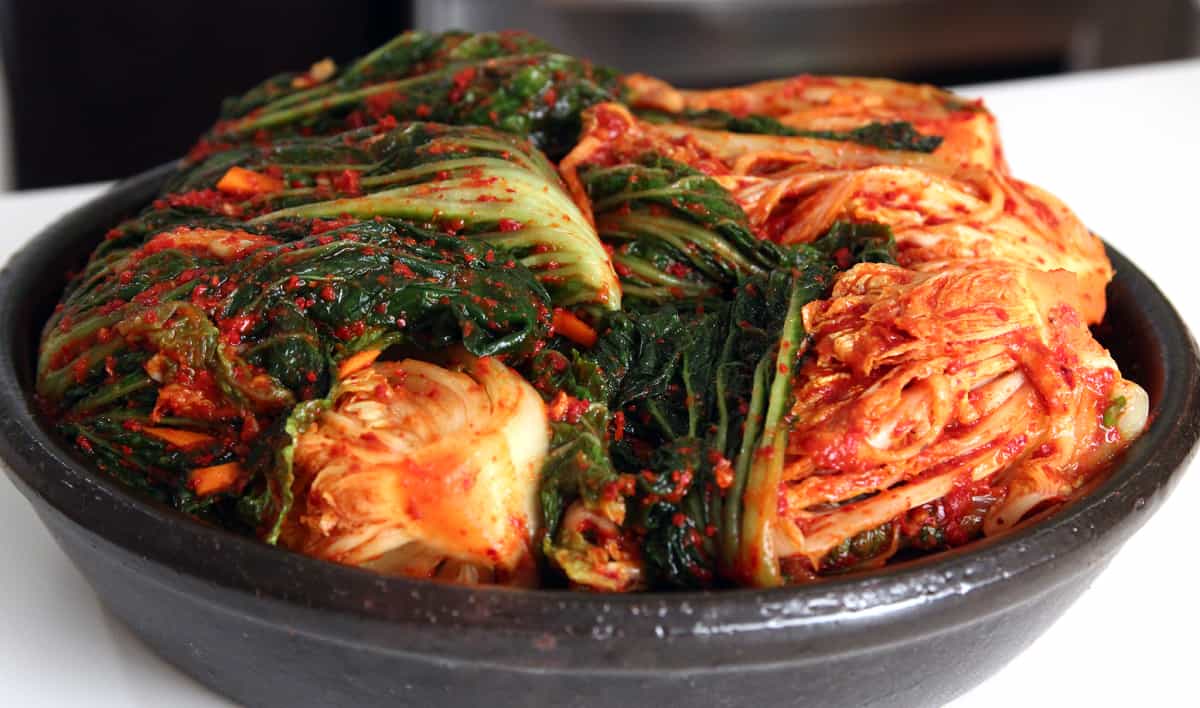
You can eat it fresh right after making or wait until it’s fermented. Put the Kimchi container at room temperature for 1 or 2 days and keep it in the refrigerator.
How do you know it’s fermented or not?
One or 2 days after, open the lid of the Kimchi container. You may see some bubbles with lots of liquids, or maybe sour smells. That means it’s already being fermented.
Buy this recipe's ingredients online
I really like Weee! they deliver quality packaged and fresh Korean ingredients to the continental USA. Cheaper and better than Amazon! Check them out!





Hi Maangchi,
Thank you for posting this recipe! This is the 4th one I’ve made from your website, and it’s delicious! I think maybe the garlic flavour is a bit strong, so next time I will put in a little less garlic. I’m taking some kimchi to my korean friend today, he will tell me how well I did :)
I have one question, I used the same hot (red) pepper flakes that I used for soondubu jigae (from the korean market), but my kimchi sauce isn’t very red. It’s still quite hot, but just doesn’t have the same red colour as yours. Why do you think that is?
Matty,
Don’t rinse the salty shrimp sauce. You must use it as it is. Yes, even though your kimchi is salty, it will become less salty as it ferments, but anyway we should not intake too much salt, right? If your kimchi turns out a little too salty, I recommend decreasing the salting period or use less amount of salt than the recipe. 3 times rinsing cabbage is very good.
Maangchi
I followed your recipe to the letter today. I used the low side of the red pepper (4 Cups) thinking it a little on the high side but it turned out to have the perfect amount of heat for my wife (who tends to like it a lot less spicey than myself) and a level that pleases both of us.
The batch turned out perfect with the exception that it is a little salty. I washed the lettuce three times thoroughly as per your instructions. Was it the salt shrimp I used that made it so salty? Should I rinse the shrimp next time I make a batch? Will the batch become less salty as it ferments?
Thanks for the recipe. I absolutely adore Kim chi but I don’t get near a Korean Grocery all that often. Now I can make it myself. I think your recipe taste better than the ASSI brand store bought I have been acustomed to lately.
Thanks again
Matty
Thank you so much for your advice Maangchi :D
Debbie,
You can skip oysters, but if you don’t add rice flour porridge to your kimchi paste, the paste will be too thick. Then it will be difficult for you to mix them all.
If you don’t like to use porridge, just forget about kimchi paste. Put all ingredients such as hot pepper flakes, garlic, ginger, fish sauce, chopped green onion… to chopped cabbage directly and mix it by hand.
Hello! Maangchi, I am from Singapore, thank you so much for sharing your Korean recipes… I love love Korean food. I just have a question, I make my kimchi almost the same way as you do, except I do not add the sweet porridge or the oysters but my paste is still quite thick as I add lots of hot pepper flakes, am I missing out something in terms of taste?
nuna,
yayee! Your kimchi soup sounds great! I lo~ve kimchi soup. I sometimes put leftover rice in it and boil for about 10 minutes to make kimchi porridge. So delicious!
hey maangchi i made kimchi same like you i eat it when it is fermented it was so good :) thn me nd my korean friend made kimchi noodles by boiling stock of DRD myulchi thn add shitake,baechu,onion and chives after it i add gochujang and tir thn i add kimchi juice and kimchi thn covered with lid thn i poured hot soup in boiled myun noodles and sesame oil wow it was so so exellent nd delecious
Andy,
of course you can. Thanks for your question and Happy Holidays!
Hi,
Do you think it would be okay to replace the onions with shallots instead?
Hi Again,
Sorry, I hit the wrong key.
My question is – Will it ferment properly if the container is not air-tight. After all, I see pictures of Korean kimchi earthen jars that are just covered over by an earthen plate. Am I right. Please advise.
Hi Maangchi,
I’m impressed with your recipe, so I tried making half portion. The paste was a bit watery. Maybe because I used hot pepper powder instead of flakes.
I store the kimchi in a Japanese jar with the cover just sitting on the lid. Your recipe requires it to be kept in air-tight sealed continer. W
Lexi,
First you will have to pick good quality radish to make crispy taste kkaktugie(radish kimchi).
Pasi,
I’m copying and pasting the comment from this thread relating to your question.
“no hot pepper paste in Kimchi making. You should get hot pepper flakes to make kimchi.
Check this out and read others’ comments and my answer, too. Thank you!
https://www.maangchi.com/ingredients/hot-pepper-flakes “
Heejin Tre,
What what? : ) I have never heard that you have to put water filled plastic bag on top of kimchi!
If you want, use heavy thing such as rocks. The reason for putting things on the top of kimchi is to protect kimchi from exposed to air!
I don’t do it though.
Hi Maangchi,
I made this recipe without the oysters (since I don’t like the stray pieces floating in there) and it was great. So much better than any restaurant I’ve been to or the kim chi from stores.
One question I had, a lot of recipes I’ve seen for kim chi tell you to put a water-filled plastic bag on top of the kimchi after it’s made instead of putting it in a sealed jar while it ripens/ferments. I did this with your recipe and like I said it tasted great, but you don’t mention this tip. Have you heard of this, and what is the purpose of doing it do you think?
Thanks for all your great recipes and all the work you do on this site.
Thanks for the recipe and the great video. I just made the radish kim chi. I was wondering if you have any tips to keep the radish crispy so it won’t be too soft over time?
Dear Maangchi
This recipe seems wonderful. I live in Sweden and Korean food is hard to come by, but I have always tried to get my hand on kimchi in Japanese restaurants. I remeber I tried to recreate kimchi once or twice without a clue about anything, not to mention fermentation…
Now I have combed the net for good kimchi receipes, and made two versions already. Improving. Third batch fermenting now. I will definately try yours next time.
But, I would really love to get your idea on a few things:
1) Some receipes use Coarse Korean pepper, others pepper paste (guchujang). A few even mix. What is behind your choice of coarse pepper?
2) Is guchujang an equivalent to coarse pepper + riceflower/water/boil?
3) Some use rice vinegar in their paste as fluid. Comments?
Thanks a bunch in advance. Be well in Toronto! =)
Hi! Mangchi,
First of all I would really like to thank you so much for posting all your wonderful Korean recipe videos. They are exceptional and I am really enjoying going through each and every one of them.
I am a huge fan of Kimchi and this is what actually brought me to your wonderful site. I really love your Kimchi recipe and cannot wait to make it. I had a question for you before I do. Is it ok, if I put the kimchi in a plastic container instead of a glass container?
I have always seen Kimchi in a glass container everywhere including your videos and I was just curious.
Thank you again so much for your kindness and for having a huge heart and sharing all your wonderful recipes.
Best regards,
Sweety
I hope you surprise your husband with you kimchi! I’m sure he will be. : )
AHA! Thank you for explaining the difference. My K-mother in law has just always called this korean style salad “kimchee”. Because I was not familiar with Korean foods until I got married, I always took her word for it. I wonder what my husband will say when I make real kimchee for the first time. LOL
Thank you again.
TT
ems,
I’m glad to hear about your successful kimchi making. Regarding your question about hotpepper paste’s taste and usage, I think you should leave your question on the forum here.
https://www.maangchi.com/talk/forum/general-discussion
TT,
The vegetable dish your mother-in-law makes is not kimchi. It’s “geotjulyee”(korean style mixed green salad) I posted the recipe with my doenjangjjigae.
https://www.maangchi.com/recipe/tofu-stew-doenjang-chigae
Maangchi,
I love your recipes and the videos are so helpful. I am a little confused though. My [Korean] mother in law makes kimchee using soy sauce, sesame oil, salt and suagar instead of fish sauce. I know that she doesn’t ever make a paste. I like her kimchee, but honestly, I’ve never tasted anyone elses (unless you count that nasty jar of kimchee from the market…yuck). Is the soy sauce, sesame oil, sugar and salt a good substitute for the fish sauce paste? Or does the fish sauce paste create a whole different flavor?
Thank you,
TT
hi!
followed your advice and the kimchi was great…it’s true that it tastes far better fresh than fermented. but either one is good.
remember i asked about red pepper paste? i’m interested in buying a jar of it…but how does it taste like? and what can i use it in? thanks!
Elin Julianti,
yayee, you can make your own delicious kimchi now! : )
Melissa Yang,
Yes, you can use flour to make porridge for kimchi paste. Don’t forget to press down the top of kimchi in the container with a spoon whenever you take some. It will prevent your kimchi from being exposed to air. If you see the top of kimchi already has white stuff, it’s fungus. You will have to remove the top layer of the kimchi. If you keep your kimchi properly, it won’t go bad months and months.
Winnie,
Please follow my recipe! Don’t add oysters separately after making kimchi!!!
Oysters will ferment along with kimchi, no problem!
Hi Maangchi,
I’m so glad I found your recipe at Youtube. I always like korean food especially kimchi. I’m going to try your kimchi recipe that use raw oysters. I have a few questions to ask. If I want the sourly taste kimchi, so I’ll have to ferment it for 2 days, but will the oysters turn bad during at room temperature? Or should I add the oysters after the kimchi has been fermented, then store in the fridge?
Thanks!!
Hi Maangchi,
Thank you for your measurement. They are very useful.
Btw, I am going to try using your recipe to make Kimchi by using flour. All these time, I didn’t use flour for kimchi making . How long can we keep Kimchi in the fridge? The last time I made Kimchi, I discovered there was some white spot on the Kimchi after it was left in the fridge for 2 months. Do you happen to know what causes the white spot? Many thanx again for the metric system.
Dear Maangchi,
Last week I made kimchi base on your recipe, and I ask my korean friend to tasted it. They said the taste is good. They wondering how can I? then I inform them that I watched your video…Thanks for sharing…Now, I am confident to make kimchi again…:-)
Hi Maangchi,
Could you advise the measurement (cup) in metric form?
For example: from cup in to ml/gram?
Thank you.
Robert Jordan,
I know what you mean! My kimchi is like that when it ferments well.
Some of the commercial kim chi’s you can buy are “sparkly” on the tongue. I guess this is due to dissolved gases intrapped in the kim chi? How can it do the same thing at home?
Will be trying your recipes!
Hi Maangchi,
I made my kimchi & succeeded !!!
This is my 5th time preparing it.
Thank you so much for sharing your recipe with me.
I’ve also changed some of the veg, and used garlic stems, spring onions, chives, leek, increased the amount of garlic to suit my taste. But I’ve yet to try it with oysters.
My family & friends love it and will always ask me if I’m preparing my next batch of kimchi.
Thank you very very much.
Love you!
Dear Maangchi,
Thanks for the video, I will try to make kimchi as soon as possible…:-)
Craig Smith,
Your story about how you got interested in Korean kimchi is very interesting! I’m glad to hear that you are planning to make your own homemade kimchi now.
I usually don’t squeeze rinsed cabbage. I drain the cabbage using a basket and let it sit for about 30 minutes. Squeezing the rinsed cabbage will take only a few minutes if you make the amount of kimchi in my recipe (2 heads of cabbage)
Yes, you can use either anchovy sauce or fish sauce.
Thanks for your interest in my recipes.
Hi Maangchi,
I was introduced to Kimchi in Tucson, Arizona of all places. I used to lunch at a local tavern and the Korean owner would put it out on the bar to snack on. It was love at first bite and remains one of my favorite foods. I now live, back east, but there is no local resource for Kimchi. When I visit NYC I always stop on 32nd St. and pick up a couple of gallons. I want to be able to eat it everyday and have decided to make my own. Your site is great and your recipe seems to be regarded as the best, and thank you.
I think I can do this. I have only two questions as your instructions are quite clear. First, how much time and effort should be spent squeezing out the water from the rinsed cabbage? (after salting) Some people claim “watery” results and is this from not squeezing out enough water? I know not to make the paste too thin. Second, I’ve found “Anchovy Sauce for Kimchi” and I love the taste of them in my Kimchi. Should I try it, or go with “fish sauce” for my first try, or are they the same? Please pardon my ignorence.
Best Regards, Craig Smith
Pottstown, Pennsylvania