

Oi naengguk is another simple but popular Korean side dish, perfect for summer. I have made so many different kinds of naengguk (cold soup) using different vegetables, but this is my most favorite recipe. The seasoning in this recipe could be changed a little according to your taste, more sugar if you like it sweeter, or more chili peppers if you like it spicier.
Oi naengguk (오이 냉국)
Ingredients: Cucumber, garlic, green chili pepper, red hot chili pepper, green onion , 1½ tbs vinegar, 1 ts salt, 1 ts fish sauce, 1 ts sugar, 1½ cup of cold water (purified or boiled and cooled down), and 6 ice cubes.
Get a bowl ready, one that can hold more than 2 cups. One that is made of glass looks the best.
Put about 1¼ cups of cucumber, cut into thin strips (julienne style), into the bowl.
Mince one clove of garlic, chop up half a green onion, and cut up 1 or 2 ts worth of green chili pepper (depending on how hot you like it). Add them to the cucumber strips in the bowl.
Add 1 ts of salt, 1 ts of fish sauce, 1 ½ tbs of vinegar, 1 ts of sugar to the bowl and mix it well with a spoon.
Pour 1½ cup of cold water (purified or boiled and cooled down) to the bowl and mix it.
Add 6 ice cubes.
Cut some red hot chili pepper to garnish and sprinkle on the top of the soup.
Serve it with rice.
You can also make naengguk with miyuk (sea plant), or egg plant, instead of cucumber. Or you can make it with mi yuk (sea plant) together with cucumber, too. You can try some different combinations to see what you like the best.
My best friend’s mother–in-law had major surgery that caused her to stay at the hospital for months. When she got out of the hospital, my friend asked, “Mom, what do you feel like eating now that you can eat any food that you want? I would like to make your favorite food, something you couldn’t eat for months!”
The mother-in-law said, “I don’t have any food that I feel like at the moment except for oi naengguk”. My friend expected her mother–in-law to say that she wanted some expensive gourmet food, but all she wanted was simple “oi naengguk”!
After meeting my friend on the day, what do you think I did when I came back home? Haha, I made a huge bowl of oi naengguk and enjoyed it, thinking about the mother-in-law. Whenever I eat oi naengguk, it reminds me of my friend’s mother-in-law.
Yes, we don’t always have to have expensive luxurious gourmet food, sometimes very humble food makes our lives happy.
Naengmyeon (“cold noodles”) is made from buckwheat and a very popular dish in Korea all year round but especially in summertime. I’m going to introduce you to 2 kinds of naengmyeon: mul naengmyeon and bibim naengmyeon, both using yeolmu mul kimchi using a recipe from my previous video.
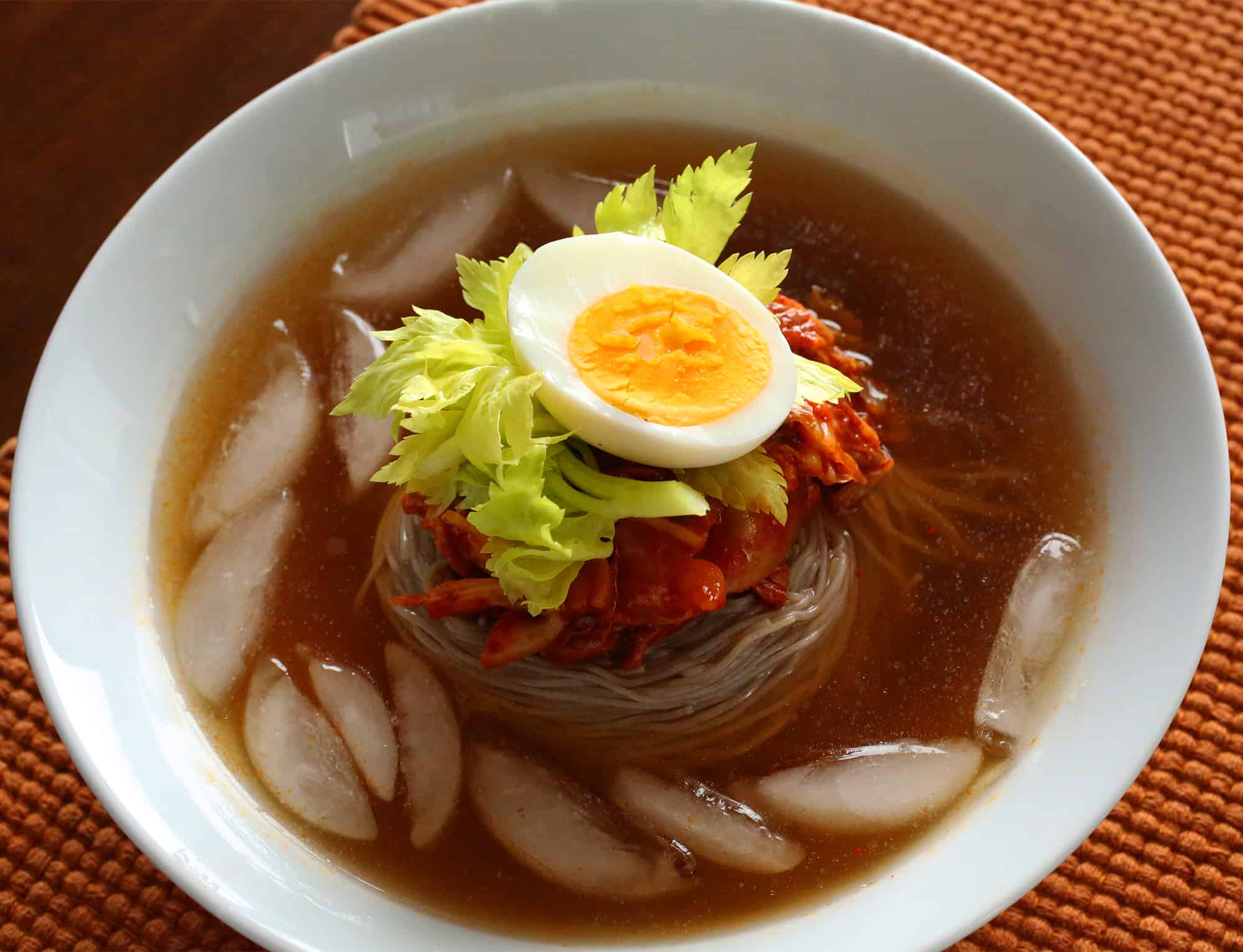
Mul naengmyeon is soup based noodles which is served with cold icy broth.
Bibim naengmyeon is served with hot and spicy sauce and not much soup.
Naengmyeon is my favorite food. I enjoy the texture of noodles while chewing it. After eating icy cold noodles in the hot summer day, you will feel your body temperature cools down.
Mustard powder:
Mix 2 tbs of mustard powder and 1 tbs water and put it on warm place to ferment it.
(I place it on the top of boiling stock)
Cucumber:
Slice a quarter of cucumber thinly and sprinkle a pinch of salt, 1 ts of sugar, 1 ts of
vinegar, and a pinch of hot pepper flakes and mix it and set it aside
Bosc pear:
Slice a half pear thinly and soak it in water and add 1 ts sugar to protect it from
changing color
Egg:
Hardboil an egg, cut it in half, and set it aside
3. Make hot and spicy sauce for bibim naengmyeon, by grinding these ingredients:
A half of peeled bosc pear, a quarter of onion (about 3 tbs), 1 ts garlic, 1 ts of ginger, ½ cup of corn syrup, 4 tbs hot pepper flakes, 3 tbs hot pepper paste, ¼ cup of apple vinegar, 1 tbs sesame seeds, 3 green onions, 1 tbs soy sauce
Place the ground sauce into a container and add 1 tbs sesame oil and 1 ts of fermented mustard and mix it.
4. Make naengmyeon broth by mixing 1 cup of Yeolmu kimchi juice and 2 cups of stock.( you can add some vinegar or salt and sugar)
5. Boil the noodles:
Put noodles into boiling water in a big pot (2/3 of the pot is filled with water). The direction of cooking noodles is on the back of the noodle package and it usually takes 3-4 minutes to boil after putting the noodles into the boiling water. You can take some sample to check if the noodles are cooked enough or not.
When the noodles are cooked, move the pot into a kitchen sink and pour cold water and remove some water and pour cold water again. This process helps the noodles get chewier.
Place the noodles into a basket or colander and keep rinsing and draining the noodles until all starch from the noodles are removed.
6. Serve it cold cold!
For mul naengmyeon:
Put some noodles into a serving bowl and fill the broth until the noodles are submerged.
Add crushed ice and place toppings: yeolmu kimchi, a few pieces of pear and cucumber, and a half side of boiled egg on top.
Add 1 ts of mustard
For bibimnaengmyeon:
Put some noodles into a serving bowl.
Add a half cup of icy broth
Place some hot and spicy sauce, yeolmu kimchi, a few pieces of pear and cucumber and a half side of boiled egg on top.
Yeolmu mul kimchi is usually eaten in summer in Korea. Making Bibimbap with barley rice, doenjang jjigae, yeolmu kimchi, hot pepper paste and sesame oil is one of the most popular and delicious dinners in hot summer. My mouth is watering while writing this explanation!
Peel the ginger skin, wash it, and slice it to make half cup.
Place the ½ cup of sliced ginger into a pot or kettle.
Rinse 5-6 cinnamon sticks and put them into the pot.
Add 7 to 7½ cups of water and boil for 20 minutes over high heat.
Lower the heat to medium and boil it for another 25 minutes. If it boils over, take off the lid.
Add 1 cup of sugar. Stir it and cool it down.
Remove the stem of each persimmon and wash them.
Remove the cinnamon sticks and sliced ginger from the tea using a colander.
Pour it into a glass jar or glass bowl and add the cleaned dried persimmons.
Cover the lid and keep it in the refrigerator for at least 12 hours. It will keep for a couple of days.
Serve cold with ice cubes. Use a ladle to give each person a small bowl of punch. Each serving should have one persimmon in it with a few pine nuts sprinkled on top.
"Debbie, You can skip oysters, but if you don’t add rice flour porridge to your kimchi paste, the paste will be too thick. Then it will be difficult for you to..."
- Maangchi in Kimchi and Kaktugi December 27, 2008
"Nishu, oh, thank you very much. I am going to post the information on the forum then. Thanks a lot."
- Maangchi in Black bean paste December 27, 2008
"lilian Ph, oh, I’m sorry to hear that! Next time, use more water and cook longer. Don’t give up! : )"
- Maangchi in Rice cake (gyungdan) December 27, 2008
"pimky, mostly it’s used in side dishes such as seaplant salads, radish salads…"
- Maangchi in Apple vinegar December 27, 2008
"Hello! Maangchi, I am from Singapore, thank you so much for sharing your Korean recipes… I love love Korean food. I just have a question, I make my kimchi..."
- Debbie in Kimchi and Kaktugi December 27, 2008
"hey maangchi i am not able to send information there so i m sending here adress of korean store in New Delhi ,India {A-Mart korean grocery store} A-1 Mahipalpur..."
- Nishu in Black bean paste December 27, 2008
"i tried making it before but at the end the dough is un-cook in the middle. and it turn out hard"
- lilian Ph. in Rice cake (gyungdan) December 26, 2008
"i want to know what is the use of vinegar in korean food? for example in salad, rice???"
- pimky in Apple vinegar December 26, 2008