

Recipes by category: spicy

Jjamppong

Here I’m introducing you to a Korean Chinese dish, jjampong. This noodle soup is one of the most popular dishes requested by my Youtube subscribers and blog readers. 

Whenever I pronounce “jjamppong,” I think it sounds funny! “JJAM PONG!”  : )

You need so many different ingredients to make good “jjamppong” as you will see in this video. It contains all the nutrients we need, so I can say a bowl of jjamppong  is a wholesome, nourishing, and well balanced meal. You can skip some ingredients or replace some ingredients with ones more easily available to you.

I prepared 2 versions of jjamppong recipe here: spicy jjamppong and non-spicy jjamppong.


Hot spicy jjamppong (1 serving)

Ingredients
Noodles for jjamppong, as well as…

for stock:
10 dried anchovies, 3 shiitake mushrooms, a handful of dried kelp (1/3 cup), half a medium size onion

meat and seafood:
¼ cup of pork, 3 large shrimp, 4 mussels, a few pieces of squid

vegetables and seasoning:
garlic, ginger, vegetable oil, oyster sauce, fish sauce, hot pepper flakes, ground black pepper, onion, carrot, green onions, leeks, white mushrooms, bamboo shoots.

Let’s start!

First step:
make stock

  1. Pour 7 cups of water into a pot. Add 10 large dried anchovies (after removing heads and guts), a handful of dried kelp, half a medium sized onion, and 3 dried shiitake mushrooms.
  2. Boil it for 10 minutes over high heat. Then lower the heat to low-medium and boil for 30 minutes more. Then set it aside

Second step:
make mixture of hot pepper flakes and vegetable oil

In a small bowl, mix 1½ tbs of hot pepper flakes and 1 tbs of vegetable oil.

*tip: The reason we make this mixture is to prevent the hot pepper flakes from floating in the soup when it boils. You can add or decrease the amount of hot pepper flakes and vegetable oil according to your taste.

Third step:
prepare seafood and meat

  1. Cut squid in half lengthwise and then cut shallow the inside part of squid in a grid pattern.
  2. Shell 3 large shrimp and 4 mussels per serving.
  3. Cut ¼ cup of pork into thin strips.

Fourth step:
prepare vegetables

  1. Slice some carrot, cabbage, napa cabbage, onion, and white mushrooms into bite sized pieces.
  2. Cut leeks and green onions into about 7 cm in length. Add some bamboo shoots.

*tip: 3-4 cups worth of vegetables are used per serving.

Fifth step:
cook noodles

Boil water in a large pot and add the noodles. Cook for a few minutes, then drain and rinse in cold water.

*tip: When you cook the noodles, take a sample to see if it’s cooked fully or not. The noodles should be soft and chewy.

Now ready to cook!

  1. In a heated pan, drop 1 tbs of vegetable oil, 2 cloves of garlic, and 1 ts of minced ginger and stir it until its color starts to change to golden brown.
  2. Put pork strips into the pan and stir fry it for 2 minutes.
  3. Put in vegetables (cabbage, napa cabbage, carrot , sliced onion, green onion, leeks, white mushrooms, and a few pieces of bamboo shoots) and stir for 3-5 minutes.
  4. Lower the heat and put the mixture of hot pepper flakes and vegetable oil into the pot. Stir it.
  5. Put in seafood (squid, shrimp, and mussels) and keep stirring.
  6. Pour 5-6 cups of stock into the pan and boil it for about 5 minutes.
  7. Skim off the foam from the top with a spoon.
  8. Add 1 tbs of fish sauce, 1 tbs of oyster sauce, and a pinch of ground black pepper.

Ready to serve!

Put some noodles in a large serving bowl and pour the soup and cooked ingredients on top of the noodles.

Serve it hot.

Enjoy!


Non-spicy jjamppong

Ingredients
A can of non-sodium chicken broth, ¼ cup of pork (cut into thin strips), 3 large shrimp, 4 mussels, squid (¼ cup),  garlic, ginger, vegetable oil, oyster sauce, fish sauce, ground black pepper, onion, carrot, green onions, leeks, white mushrooms, bamboo shoots, noodles, and Asian chives.

First step:
prepare seafood and meat

  1. Prepare seafood by cutting squid into bite sized pieces, shelling 3 large shrimp, and washing 4 mussels.
  2. Cut pork into thin strips (¼ cup worth).

Second step:
prepare vegetables

  1. Cut some carrot, cabbage, napa cabbage, onion, and white mushrooms into bite sized pieces.
  2. Cut leeks, green onions, and Asian chives into pieces about 7 cm long.

*tip: use 3-4 cups of vegetables per serving

Ready to cook?

  1. Drop 1½ tbs of vegetable oil and 2 cloves of chopped garlic and 1 ts of minced ginger into a heated pan. Stir it until it starts to go golden brown.
  2. Put pork strips into the pan and stir fry it for 2 minutes
  3. Put vegetables (cabbage, napa cabbage, a few sliced carrot, onion, green onions, and leeks, white mushrooms, and bamboo shoots) into the pan and stir them for 3-5 minutes.
  4. Put seafood into the pan and stir it for 1 minute.
  5. Pour a can of chicken broth into the pan and 2 cans of water from the can (that’s a total of 5-6 cups of liquid).
  6. Skim off the foam from the top with a spoon.
  7. Add 1 tbs of fish sauce and 1 tbs of oyster sauce.
  8. Put noodles into the boiling soup and cook for a few minutes until the noodles are cooked but still soft.
  9. Turn off the heat and add some Asian chives (1/4 cup) and a pinch of ground black pepper.
  10. Transfer it into a large serving bowl and serve it hot.

Soondubu jjigae (soft tofu stew)

Ingredients:

Prepare stock to make tasty Soon du bu:

  1. Pour 5 cups of water into a pot and add 12 dried anchovies after removing intestine part.
  2. Add half onion, some dried kelp (about 1/3 cup), 3 dried shiitake mushrooms, 5 cloves of garlic and boil it over high heat.
  3. Approximately 10 minutes later, lower the heat to low medium heat and boil it for another 20 minutes.
  4. Set aside the stock and take out the mushrooms and chop them into small pieces.
  5. Heat your earthen ware (or ceramic pot) on the stove and put 2 ts of olive oil.
  6. Chop 100 grams of beef and put it into the pot and stir it.
  7. Add the chopped shiitake mushroom and stir it.
  8. Add 2 tbs – 5 tbs (1/4 cup) of hot pepper flakes and keep stirring for 1 minute.
    * Tips:
    2 tbs—mild
    3 tbs—medium
    4 tbs—hot
    5 tbs (1/4 cup)—suicidal hot ! : )
  9. Pour 2 cups of the stock you made. It will be sizzling. Don’t be afraid! It’s just TOFU stew! : )
  10. Add 1 cup of mixed seafood and 3 shirimp.
  11. Add 2 tbs of fish sauce.
  12. Cut the 2 tubes of Soon du bu (soft Tofu) in half and squeeze it out into the pot and break the tofu with a spoon several times in the pot.
  13. When it boils, add 2 chopped green onions and 1 green chili pepper.
  14. Crack eggs and drizzle some sesame oil before serving.

Enjoy it!

Kimchi stew (kimchi chigae) and soybean sprout side dish (kongnamool)

Kimchi stew is one of Koreans’ most favorite dishes all the year around. When you eat kimchi stew with rice, you won’t need any other side dishes. You can replace pork with a can of tuna or even 2 cans of tuna. : )

Ingredients:

Ok, let’s start!

  1. In a shallow pot, put some chopped kimchi and juice.
  2. Add sliced onion, hot pepper paste, and hot pepper flakes, sugar, and green onions.
  3. Pour water until all ingredients are submerged.
  4. Close the lid of the pot and boil it 25 or 30 minutes. (first 10 minutes will be high heat and then turn down the heat over medium heat)
  5. Add some tofu and boil it 5 minutes more and put some sesame oil right before serving.

soybean sprouts side dish (kongnamul muchim)

Ingredients:

  1. Rinse and drain a package of soybean sprouts a few times over. Pick out any rotten sprouts.
  2. Put the soybean sprouts into a pot.
  3. Add 2 ts of salt and 1 cup of water. Close the lid.
  4. Bring to a boil over high heat, and boil for 15 minutes.
  5. Drain the cooked soybean sprouts and let them cool down.
  6. Put the soybean sprouts in a large bowl with 2 cloves of minced garlic, 2 chopped green onions,1 tbs of soy sauce, 1 ts of salt, ½ ts of sugar, 1 tbs of sesame oil, and ½ -1 ts of hot pepper flakes (optional). Mix it by hand.
  7. Transfer it onto a plate and sprinkle some roasted sesame seeds over top.

Enjoy it!

Spicy beef and vegetable soup (yukgaejang)

This time I posted spicy beef and vegetable soup (Yuk Gae Jang) on YouTube.

Ingredients:
1 Lb of beef brisket, half an onion, water, 12 green onions, 5 cups of bean sproutsfern brakes (kosari),

1 stalk of  celery, garlic, hotpepper flakessesame oil,  vegetable oil, salt,  soy sauce, and black pepper

  1. In a big pot, add beef brisket, 14-15 cups of water, and half an onion, then boil it for 40-50 minutes over high heat.
  2. Cut the green onions, celery, and fern brakes (kosari) into pieces about 7 cm in length. Put them all into a big bowl.
  3. Put 3 tbs hotpepper flakes, 1 tbs of sesame oil, 1 tbs of vegetable oil, 1 tbs soy sauce, 1 tbs of salt, and some grounded black pepper into a small bowl and mix it. This is your hotpepper oil sauce.
  4. Put the hotpepper oil sauce into the vegetables mixture and mix them all up.
  5. When the beef is well cooked, take it out and set it aside to cool down.
  6. Add the mixture of vegetables and hotpepper oil sauce into the boiling beef stock. Boil it for 20-30 minutes.
  7. Slice the beef thinly and add it into the boiling soup. Cook it about 5-10 minutes more.

Serve with rice. Enjoy it!

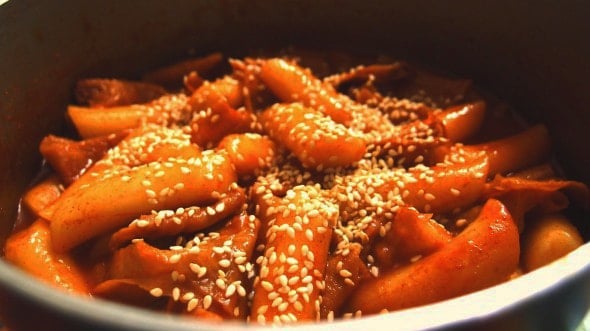
Hot and spicy rice cake (ddukbokkie)

There are 2 kinds of recipes for ddukbokkie. One is mild taste ddukbokkie without using hot pepper paste and the other is the dish I am making in this video.

Ingredients for hot spicy ddukbokkie:
Tube shaped rice cake for ddukbokkie (about 300 grams)hot pepper paste,  sugar, water,  dried anchovies, and green onions.

  1. Separate the tubes of rice cake into individual pieces.
  2. In a pan, pour 4 cups of water and add 7 large dried anchovies after removing their heads and intestines. Boil the water for 10 minutes over medium heat.
  3. Remove the anchovies and add the rice cakes, 4-6 tbs of hotpepper paste, 1 tbs of sugar, and 1 tbs of hotpepper flakes (optional). Stir it constantly.
  4. Cut 7 green onions into 5 cm long pieces, and add them to the pot.
  5. Keep stirring until the sauce is thick and the rice cake is shiny.
  6. Transfer it to a plate and serve!

How to make mild taste ddukbokkie:

1 package of rice cake

  1. Saute 200 grams of beef strips with 2 tbs soy sauce, 1 tbs sugar, 2 cloves minced garlic, and 3 tbs of sliced onion.
  2. Add 3-4 sliced white mushrooms   and 2 chopped green onions to “1″  and stir it.
  3. Add 1cup of water and put rice cake in it and keep folding until rice cake is soft
  4. Serve it on a plate and eat it when it is warm

When I lived in Korea, I went to a very popular “ddukbokkie” place located in a big market. The owner was an old lady and she kept stirring her ddukbokkie. People were lining up to buy her ddukbokkie. She was a kind of a famous ddukbokkie seller. I learned from her to make tasty ddukbokkie, dried anchovies are needed. One day I ran out of dried anchovies, but I made ddukbokkie. It didn’t taste like I expected. So don’t forget to make good stock using dried anchovies to make delicious ddukbokkie.

Stir-fried squid (ojinguh bokkeum)

Hot and spicy stir fried squid

Ingredients:

Makes 2 servings.

  1. Remove the squid’s intestines
  2. Wash and drain the squid. Cut it into strips (about 2-3 cups worth) and place them in a bowl.
  3. Prepare a big plate for your vegetables.
  4. Cut a carrot thinly and diagonally and place it on a big plate.
  5. Cut 12 green onions into pieces 5-7 cm in length and put them on the plate.
  6. Slice 1 medium size onion and put it on the plate.
  7. Slice 1 green chili pepper and put it on the plate.
  8. Prepare a small bowl and make hot paste by mixing 5 cloves of minced garlic, 2½ tbs of soy sauce, 2 tbs hot pepper flakes, and 1 tbs sugar.
  9. Heat a pan or wok over high heat and put 1 tbs olive oil in it.
  10. Stir fry by adding vegetables in this order: carrots, onions, green onions, and chili pepper. Stir fry for about 2 minutes
  11. Add squid strips and the hot paste and continue to stir fry for a few minutes
  12. Sprinkle some sesame oil and transfer to a serving dish and serve with rice.

Recent Comments:

  • "Thank you so much for your advice Maangchi :D"
    - Debbie in Kimchi and Kaktugi
    December 27, 2008
  • "oh its my plesure actually you are the only one which i have to thank that you show so much nice vds and with details thnks so much and wish you a very very very Happy..."
    - Nishu in Black bean paste
    December 27, 2008
  • "Debbie, You can skip oysters, but if you don’t add rice flour porridge to your kimchi paste, the paste will be too thick. Then it will be difficult for you to..."
    - Maangchi in Kimchi and Kaktugi
    December 27, 2008
  • "Nishu, oh, thank you very much. I am going to post the information on the forum then. Thanks a lot."
    - Maangchi in Black bean paste
    December 27, 2008
  • "Dominique, Yes, you can use chicken or anchovy stock instead of beef. If you like milky color soup, do this way. In a..."
    - Maangchi in Seaplant soup (miyuk guk) and seaplant salad (miyuk muchim)
    December 27, 2008
  • "lilian Ph, oh, I’m sorry to hear that! Next time, use more water and cook longer. Don’t give up! : )"
    - Maangchi in Rice cake (gyungdan)
    December 27, 2008
  • "pimky, mostly it’s used in side dishes such as seaplant salads, radish salads…"
    - Maangchi in Apple vinegar
    December 27, 2008
  • "Hello! Maangchi, I am from Singapore, thank you so much for sharing your Korean recipes… I love love Korean food. I just have a question, I make my kimchi..."
    - Debbie in Kimchi and Kaktugi
    December 27, 2008
  • "hey maangchi i am not able to send information there so i m sending here adress of korean store in New Delhi ,India {A-Mart korean grocery store} A-1 Mahipalpur..."
    - Nishu in Black bean paste
    December 27, 2008
  • "Hi Maanchi, Thankyou for your delicious receipe! I’ve made seaweed soup so many time but this was the first time it..."
    - Dominique in Seaplant soup (miyuk guk) and seaplant salad (miyuk muchim)
    December 27, 2008
  • "i tried making it before but at the end the dough is un-cook in the middle. and it turn out hard"
    - lilian Ph. in Rice cake (gyungdan)
    December 26, 2008
  • "i want to know what is the use of vinegar in korean food? for example in salad, rice???"
    - pimky in Apple vinegar
    December 26, 2008

Recent discussions:

These are photos sent to me by readers who cooked my recipes. Send me a photo of the food you make and I will put it here. You can see more photos on my photos page.

Arianna Wasserburger's dakkangjung (sweet and crispy chicken)Amy King's mandujenny's hobakjuk (butternut squash or sweet pumpkin porridge)Aga Suka's galbijjimFrank Seo's chiken dish (dakkangjung)Megan Carroll's  Korean dishesiJessica's Korean dishesQiu's butternut squash porridgeAmy's dakkangjungSirena Tse's kimchiSirena's kongjang (soybean side dish)Anne Marit Vik's bibimbap

Bloggers who made my recipes

maangchi.com page views:

website stats