

Recipes by category: noodles

Jjamppong

Here I’m introducing you to a Korean Chinese dish, jjampong. This noodle soup is one of the most popular dishes requested by my Youtube subscribers and blog readers. 

Whenever I pronounce “jjamppong,” I think it sounds funny! “JJAM PONG!”  : )

You need so many different ingredients to make good “jjamppong” as you will see in this video. It contains all the nutrients we need, so I can say a bowl of jjamppong  is a wholesome, nourishing, and well balanced meal. You can skip some ingredients or replace some ingredients with ones more easily available to you.

I prepared 2 versions of jjamppong recipe here: spicy jjamppong and non-spicy jjamppong.


Hot spicy jjamppong (1 serving)

Ingredients
Noodles for jjamppong, as well as…

for stock:
10 dried anchovies, 3 shiitake mushrooms, a handful of dried kelp (1/3 cup), half a medium size onion

meat and seafood:
¼ cup of pork, 3 large shrimp, 4 mussels, a few pieces of squid

vegetables and seasoning:
garlic, ginger, vegetable oil, oyster sauce, fish sauce, hot pepper flakes, ground black pepper, onion, carrot, green onions, leeks, white mushrooms, bamboo shoots.

Let’s start!

First step:
make stock

  1. Pour 7 cups of water into a pot. Add 10 large dried anchovies (after removing heads and guts), a handful of dried kelp, half a medium sized onion, and 3 dried shiitake mushrooms.
  2. Boil it for 10 minutes over high heat. Then lower the heat to low-medium and boil for 30 minutes more. Then set it aside

Second step:
make mixture of hot pepper flakes and vegetable oil

In a small bowl, mix 1½ tbs of hot pepper flakes and 1 tbs of vegetable oil.

*tip: The reason we make this mixture is to prevent the hot pepper flakes from floating in the soup when it boils. You can add or decrease the amount of hot pepper flakes and vegetable oil according to your taste.

Third step:
prepare seafood and meat

  1. Cut squid in half lengthwise and then cut shallow the inside part of squid in a grid pattern.
  2. Shell 3 large shrimp and 4 mussels per serving.
  3. Cut ¼ cup of pork into thin strips.

Fourth step:
prepare vegetables

  1. Slice some carrot, cabbage, napa cabbage, onion, and white mushrooms into bite sized pieces.
  2. Cut leeks and green onions into about 7 cm in length. Add some bamboo shoots.

*tip: 3-4 cups worth of vegetables are used per serving.

Fifth step:
cook noodles

Boil water in a large pot and add the noodles. Cook for a few minutes, then drain and rinse in cold water.

*tip: When you cook the noodles, take a sample to see if it’s cooked fully or not. The noodles should be soft and chewy.

Now ready to cook!

  1. In a heated pan, drop 1 tbs of vegetable oil, 2 cloves of garlic, and 1 ts of minced ginger and stir it until its color starts to change to golden brown.
  2. Put pork strips into the pan and stir fry it for 2 minutes.
  3. Put in vegetables (cabbage, napa cabbage, carrot , sliced onion, green onion, leeks, white mushrooms, and a few pieces of bamboo shoots) and stir for 3-5 minutes.
  4. Lower the heat and put the mixture of hot pepper flakes and vegetable oil into the pot. Stir it.
  5. Put in seafood (squid, shrimp, and mussels) and keep stirring.
  6. Pour 5-6 cups of stock into the pan and boil it for about 5 minutes.
  7. Skim off the foam from the top with a spoon.
  8. Add 1 tbs of fish sauce, 1 tbs of oyster sauce, and a pinch of ground black pepper.

Ready to serve!

Put some noodles in a large serving bowl and pour the soup and cooked ingredients on top of the noodles.

Serve it hot.

Enjoy!


Non-spicy jjamppong

Ingredients
A can of non-sodium chicken broth, ¼ cup of pork (cut into thin strips), 3 large shrimp, 4 mussels, squid (¼ cup),  garlic, ginger, vegetable oil, oyster sauce, fish sauce, ground black pepper, onion, carrot, green onions, leeks, white mushrooms, bamboo shoots, noodles, and Asian chives.

First step:
prepare seafood and meat

  1. Prepare seafood by cutting squid into bite sized pieces, shelling 3 large shrimp, and washing 4 mussels.
  2. Cut pork into thin strips (¼ cup worth).

Second step:
prepare vegetables

  1. Cut some carrot, cabbage, napa cabbage, onion, and white mushrooms into bite sized pieces.
  2. Cut leeks, green onions, and Asian chives into pieces about 7 cm long.

*tip: use 3-4 cups of vegetables per serving

Ready to cook?

  1. Drop 1½ tbs of vegetable oil and 2 cloves of chopped garlic and 1 ts of minced ginger into a heated pan. Stir it until it starts to go golden brown.
  2. Put pork strips into the pan and stir fry it for 2 minutes
  3. Put vegetables (cabbage, napa cabbage, a few sliced carrot, onion, green onions, and leeks, white mushrooms, and bamboo shoots) into the pan and stir them for 3-5 minutes.
  4. Put seafood into the pan and stir it for 1 minute.
  5. Pour a can of chicken broth into the pan and 2 cans of water from the can (that’s a total of 5-6 cups of liquid).
  6. Skim off the foam from the top with a spoon.
  7. Add 1 tbs of fish sauce and 1 tbs of oyster sauce.
  8. Put noodles into the boiling soup and cook for a few minutes until the noodles are cooked but still soft.
  9. Turn off the heat and add some Asian chives (1/4 cup) and a pinch of ground black pepper.
  10. Transfer it into a large serving bowl and serve it hot.

Naengmyeon (cold noodles)

Naengmyeon (“cold noodles”) is made from buckwheat and a very popular dish in Korea all year round but especially in summertime. I’m going to introduce you to 2 kinds of naengmyeon: mul naengmyeon and bibim naengmyeon, both using yeolmu mul kimchi using a recipe from my previous video.

Mul naengmyeon is soup based noodles which is served with cold icy broth.

Bibim naengmyeon is served with hot and spicy sauce and not much soup.

Naengmyeon is my favorite food. I enjoy the texture of noodles while chewing it. After eating icy cold noodles in the hot summer day, you will feel your body temperature cools down.

INGREDIENTS:

(2 servings)

1. Make stock by boiling 8 cups of water, 3-4 shiitake mushrooms, dried kelp, and 8-10 dried anchovies (You will see how to make this stock in my soon du bu video) and cool it down.

2. Prepare toppings for naengmyeon

  • Mustard powder:
    Mix 2 tbs of mustard powder and 1 tbs water and put it on warm place to ferment it.
    (I place it on the top of boiling stock)
  • Cucumber:
    Slice a quarter of cucumber thinly and sprinkle a pinch of salt, 1 ts of sugar, 1 ts of
    vinegar, and a pinch of hot pepper flakes and mix it and set it aside
  • Bosc pear:
    Slice a half pear thinly and soak it in water and add 1 ts sugar to protect it from
    changing color
  • Egg:
    Hardboil an egg, cut it in half, and set it aside

3. Make hot and spicy sauce for bibim naengmyeon, by grinding these ingredients:

A half of peeled bosc pear, a quarter of onion (about 3 tbs), 1 ts garlic, 1 ts of ginger, ½ cup of corn syrup, 4 tbs hot pepper flakes, 3 tbs hot pepper paste, ¼ cup of apple vinegar, 1 tbs sesame seeds, 3 green onions, 1 tbs soy sauce

Place the ground sauce into a container and add 1 tbs sesame oil and 1 ts of fermented mustard and mix it.

4. Make naengmyeon broth by mixing 1 cup of Yeolmu kimchi juice and 2 cups of stock.( you can add some vinegar or salt and sugar)

5. Boil the noodles:

  1. Put noodles into boiling water in a big pot (2/3 of the pot is filled with water). The direction of cooking noodles is on the back of the noodle package and it usually takes 3-4 minutes to boil after putting the noodles into the boiling water. You can take some sample to check if the noodles are cooked enough or not.
  2. When the noodles are cooked, move the pot into a kitchen sink and pour cold water and remove some water and pour cold water again. This process helps the noodles get chewier.
  3. Place the noodles into a basket or colander and keep rinsing and draining the noodles until all starch from the noodles are removed.

6. Serve it cold cold!

For mul naengmyeon:

  • Put some noodles into a serving bowl and fill the broth until the noodles are submerged.
  • Add crushed ice and place toppings: yeolmu kimchi, a few pieces of pear and cucumber, and a half side of boiled egg on top.
  • Add 1 ts of mustard

For bibimnaengmyeon:

  • Put some noodles into a serving bowl.
  • Add a half cup of icy broth
  • Place some hot and spicy sauce, yeolmu kimchi, a few pieces of pear and cucumber and a half side of boiled egg on top.
  • Add some more sesame oil if you want.

Jjajangmyun (blackbean noodles)

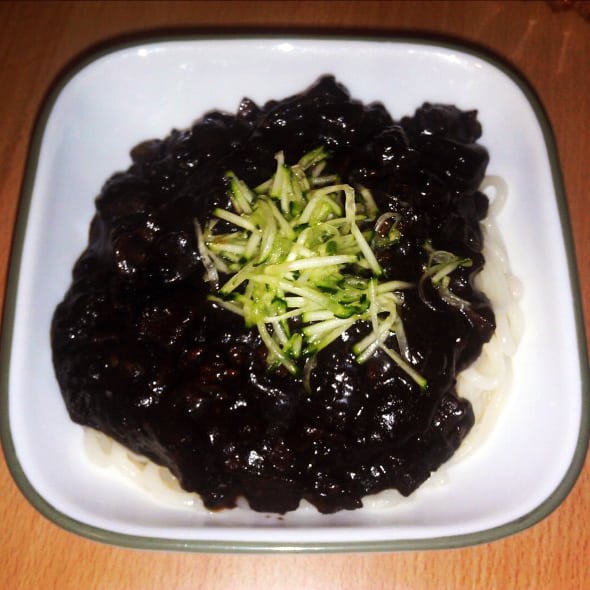
Let me introduce you to jjajangmyun. I realized recently why so many people have requested this dish. One of my youtube commenters from Hong Kong said she has seen Koreans eating jjajangmyun very often in a Korean drama. She said the noodles looked very delicious. I was not surprised at her comment because food has a very close connection with culture.

Korean dramas are popular in other Asian countries which are not only stories but also all kinds of things such as food, fashion, and style of make up.

Jjajangmyun is everybody’s favorite food. When I was young, one plate of jja jang myun from a Chinese restaurant always made me excited. We usually order Jja jang myun from a Chinese restaurant and a delivery man brings noodles contained in a specially made tin box in 30 minutes.

I usually ended up covered in jjajang sauce and my mom gave me a Kleenex!

Ingredients:
Noodles (special “myun” for jjajangmyun), black bean paste, half pound of pork belly, sugar, olive oil, potato starch powder, sesame oil, Asian radish, potato, zucchini, onion, cucumber.

Makes 4 servings.

  1. Cut the of pork into ½ inch (1cm) cubes. Leave the skin on.
  2. Add  ½ tbs of olie oil to a heated wok. When that’s hot, add the pork and stir fry it until it looks crispy.
  3. When the pork is well cooked and the color turns golden brown, drain all the hot fat and set the pork aside. Leave it in the wok, we’re going to use this later.
  4. Preheat a small skillet over medium heat with 2 tbs of vegetable oil. When that’s hot, add 7 tbs of black bean paste and stir fry for 1 minute.
  5. Remove the extra oil and set the black bean paste aside.

Cut all vegetables into 0.5 inch cubes and place them on a big plate or tray. You will end up with 1 cup of radish, 1 cup of potato, 1 cup of zucchini, and 2 cups of onion.

  1. Reheat the crispy pork in your wok over high heat, and add 1 tbs of olive oil.
  2. Add radish and potato and saute them for 2 minutes. Then add zucchini and onion and saute them for another 2 minutes.
  3. Add 3 cups of water until all the ingredients are submerged, and close the lid and boil it for 15-20 minutes.
  4. Open the lid of the wok and skim off the foam from the surface. Add the fried black bean paste from the small skillet and stir it up.
    *tip: to check if ingredients are cooked or not, try a sample potato chunk. It should be cooked, not raw.
  5. Mix 2-3 tbs potato starch powder (or corn starch) and 2 tbs water and add it into the boiling soup and stir it. Then the soup will turn into a sticky sauce.
    YOU MADE JJAJANG SAUCE!

Now, let’s cook the noodles (“myun”)

For 2 servings, you will need one bunch of noodles from the package.

  1. Boil water in a big pot, add the noodles and close the lid. Cook for a few minutes according to the direction on the package (around 3 minutes).
  2. Try one sample noodle to check if it’s cooked properly or not. It should be soft and not stiff at all. If it’s cooked, drain the noodles and place them on a large plate or bowl.
  3. Reheat the jjajang sauce and put it on the noodles

Serving:
Don’t eat it cold : )

Garnish with cucumber strips on the top of jjajang sauce and serve it with kimchi or yellow pickled radish.

Japchae (stir fried noodles with vegetables)

Since I started my cooking video, lots of people have requested a video for Jobchae.This dish is one of Korean’s favorite traditional dishes.

Ingredients:

Makes 4 servings.

How to prepare your ingredients before stir frying:

  1. Soak 5 dried shitake mushrooms in warm water for a few hours until they become soft. Squeeze the water out of them and slice thinly.
  2. Slice a package of white mushrooms (2 cups’ worth).
  3. Cut a carrot into thin matchstick-shaped pieces 5 cm long.
  4. Cut 7 -8 green onions into 7 cm long pieces.
  5. Slice one onion thinly.
  6. Slice 150 grams of beef into thin strips.

Now let’s start!

  1. Boil 2 bunches of noodles in boiling water in a big pot for about 3 minutes. When the noodles are soft, drain them and put in a large bowl.
  2. Cut the noodles several times by using scissors and add 1 tbs of soy sauce and 1 tbs of sesame oil. Mix it up and set aside.
    *tip: Take one sample and taste it to see whether or not it’s cooked properly. If it feels soft, it’s finished.
  3. In the boiling water, add a bunch of spinach and stir it gently for 1 minute. Then take it out and rinse it in cold water 3 times. Remove any grit or dead leaves thoroughly while rinsing. Squeeze it gently to get the water out, then cut it into 5 cm pieces.
  4. Add ½ tbs soy sauce and ½ tbs sesame oil and mix it and place it onto the large bowl.
    *tip: When you drain the hot water from the pot, don’t discard the hot water. Put it back into the pot so you can cook your spinach quickly.
  5. On a heated pan, put a few drops of olive oil and your carrot strips and stir it with a spatula for 30 seconds. Put it into the large bowl (don’t burn it!).
  6. Place a few drops of olive oil on the pan and add your sliced onion. Stir it until the onion looks translucent. Put it into the large bowl with your carrots.
  7. Place a few drops of olive oil on the pan and add the sliced white mushrooms. Stir it for a bit and then put it in the large bowl.
  8. Place a few drops of olive oil on the pan and add your green onions. Stir for 1 minute and put it into the large bowl.
  9. Place a few drops of olive oil on the pan and add your beef strips and your sliced shitake mushrooms. Stir it until it’s cooked well, then add 3 cloves of minced garlic, ½ tbs soy sauce and ½ tbs sugar. Stir for another 30 seconds and then put it into the large bowl.
  10. Add 2 tbs of soy sauce, 3 tbs of sugar, 2 tbs of sesame oil, and 1 ts of ground pepper to the large bowl. Mix all ingredients, then sprinkle 1 tbs of toasted sesame seeds on the top.
  11. Serve with rice and Kimchi, or as a side dish.

Recent Comments:

  • "Thank you so much for your advice Maangchi :D"
    - Debbie in Kimchi and Kaktugi
    December 27, 2008
  • "oh its my plesure actually you are the only one which i have to thank that you show so much nice vds and with details thnks so much and wish you a very very very Happy..."
    - Nishu in Black bean paste
    December 27, 2008
  • "Debbie, You can skip oysters, but if you don’t add rice flour porridge to your kimchi paste, the paste will be too thick. Then it will be difficult for you to..."
    - Maangchi in Kimchi and Kaktugi
    December 27, 2008
  • "Nishu, oh, thank you very much. I am going to post the information on the forum then. Thanks a lot."
    - Maangchi in Black bean paste
    December 27, 2008
  • "Dominique, Yes, you can use chicken or anchovy stock instead of beef. If you like milky color soup, do this way. In a..."
    - Maangchi in Seaplant soup (miyuk guk) and seaplant salad (miyuk muchim)
    December 27, 2008
  • "lilian Ph, oh, I’m sorry to hear that! Next time, use more water and cook longer. Don’t give up! : )"
    - Maangchi in Rice cake (gyungdan)
    December 27, 2008
  • "pimky, mostly it’s used in side dishes such as seaplant salads, radish salads…"
    - Maangchi in Apple vinegar
    December 27, 2008
  • "Hello! Maangchi, I am from Singapore, thank you so much for sharing your Korean recipes… I love love Korean food. I just have a question, I make my kimchi..."
    - Debbie in Kimchi and Kaktugi
    December 27, 2008
  • "hey maangchi i am not able to send information there so i m sending here adress of korean store in New Delhi ,India {A-Mart korean grocery store} A-1 Mahipalpur..."
    - Nishu in Black bean paste
    December 27, 2008
  • "Hi Maanchi, Thankyou for your delicious receipe! I’ve made seaweed soup so many time but this was the first time it..."
    - Dominique in Seaplant soup (miyuk guk) and seaplant salad (miyuk muchim)
    December 27, 2008
  • "i tried making it before but at the end the dough is un-cook in the middle. and it turn out hard"
    - lilian Ph. in Rice cake (gyungdan)
    December 26, 2008
  • "i want to know what is the use of vinegar in korean food? for example in salad, rice???"
    - pimky in Apple vinegar
    December 26, 2008

Recent discussions:

These are photos sent to me by readers who cooked my recipes. Send me a photo of the food you make and I will put it here. You can see more photos on my photos page.

Arianna Wasserburger's dakkangjung (sweet and crispy chicken)Amy King's mandujenny's hobakjuk (butternut squash or sweet pumpkin porridge)Aga Suka's galbijjimFrank Seo's chiken dish (dakkangjung)Megan Carroll's  Korean dishesiJessica's Korean dishesQiu's butternut squash porridgeAmy's dakkangjungSirena Tse's kimchiSirena's kongjang (soybean side dish)Anne Marit Vik's bibimbap

Bloggers who made my recipes

maangchi.com page views:

website stats