Korean cuisine uses a range of tofu, from silken, or soft tofu to medium-firm to firm. You can usually find a few different kinds of tofu at a grocery store. The tofu above is a medium soft tofu used for stew, and I use it in my doenjang-jjigae and kimchi-jjigae videos. There are 3 white Korean letters […]
Soy sauce has a real unique taste: it’s salty and a little sweet. When you go to a Korean grocery store, you’ll find that they stock many different kinds of soy sauce, usually without English labels. Personally I always use jin-ganjang (진간장), and have been using the Sempio brand for decades. Unlike traditional Korean guk-ganjang […]
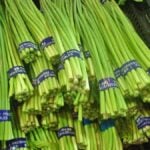
Garlic scapes are the flower bud and stem of the garlic plant. If you let them grow, they’ll get tough, the ends will bloom, and the roots will become garlic. So for this reason you need to pick and eat them when they are young and in season, around May and June. A lot of […]
These clumps of small mushrooms, with thin, 4- to 5-inch-long stems, are used widely in Asian cuisine. Buy firm, white mushrooms that aren’t slippery at all.
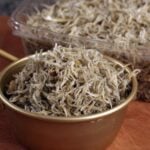
Dried anchovies are sold in plastic bags or boxes, sorted by size. Smaller anchovies (mareun janmyeolchi 마른 잔멸치) are used in stir-fries and toasted whole with soy sauce and chili paste to serve, bones and all, as a side dish with rice or as a snack. Large anchovies (gukmulyong mareunmyeolchi 국물용 마른멸치), around 3½ inches […]
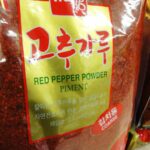
Korean hot pepper flakes are an essential ingredient in Korean cooking, used in many side dishes, soups, and stews, and in the most important Korean side dish of all, kimchi. They come in mild (deol-maewoon gochu-garu 덜매운 고춧가루) and hot (maewoon gochu-garu 매운 고춧가루) versions. For dishes like kimchi, I use the milder flakes so […]
These noodles are made from sweet potato starch and are nearly transparent after they’ve been cooked. They’re essential for making japchae. In a pinch you can substitute with cellophane noodles (a.k.a. “glass noodles”) or Chinese vermicelli, which are similar but made with mung bean starch. Look for them in Korean grocery stores. Seal the package […]
Pork belly is the boneless cut of fatty meat from the belly of a pig. Koreans love this cut of pork and it’s used often in Korean cuisine. The Korean name – samgyeopsal – literally translated means “3 layers of flesh” and refers to the three layers of meat you can supposedly find in the […]
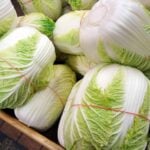
Napa cabbage is the main ingredient in traditional kimchi. You can find it in almost any grocery store and in farmers’ markets, although the cabbages sold at a Korean grocery store are always cheaper, bigger, and better tasting. In the kimchi-making season of late fall, when napa cabbages are at their best, Korean grocery stores sell […]
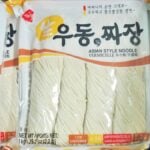
Often mislabeled as Asian or oriental-style noodles or vermicelli, these thick, chewy wheat noodles, used for jjajangmyeon (Noodles with black bean paste), are sold frozen in Korean grocery stores. Thaw them out if you’re going to use them right away, otherwise store them in your freezer in a ziplock bag and thaw them out a […]
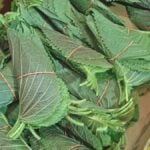
Fresh green perilla leaves are popular in Korean cuisine. Their flavor is somewhere between that of basil and mint. We use them whole in ssam wraps and barbecue, or shredded to add a bit of minty flavor to many other dishes. We also pickle them and make perilla kimchi with them. Perilla leaves are often […]
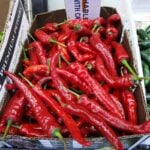
These are green chili peppers that have ripened. They are tangier, a little sweeter, and a little less spicy. We use them in the garnishes of many sidedishes (banchan). You can substitute chopped or shredded red bell pepper.
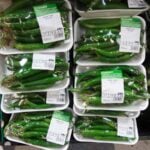
There are many kinds of green chili peppers in Korea, some spicy and some not, and the Korean word cheong-gochu includes all of them. They are usually 3 to 4 inches long and look like long jalapeños, but they are pointier. They have a sweet flavor, and their spiciness can range from very mild (asagi […]